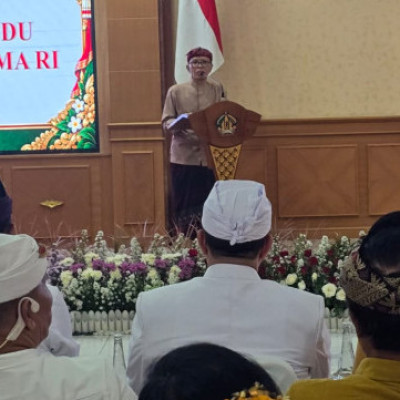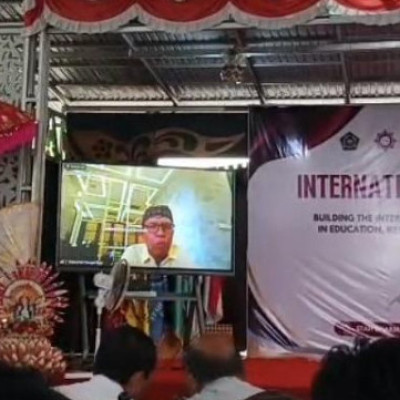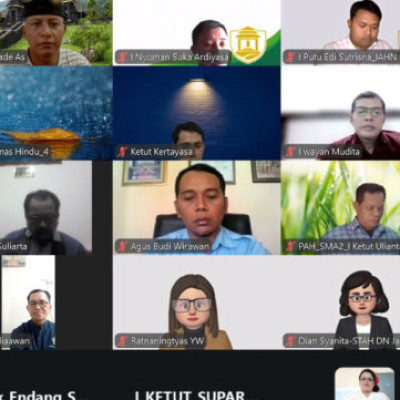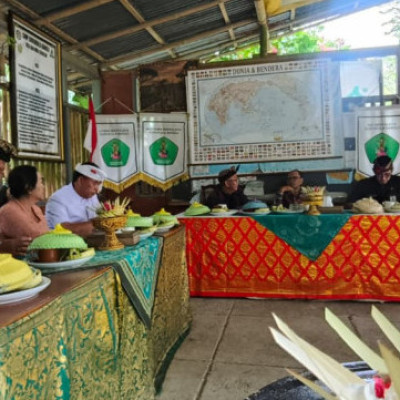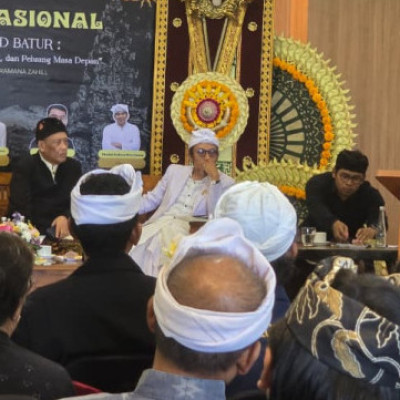

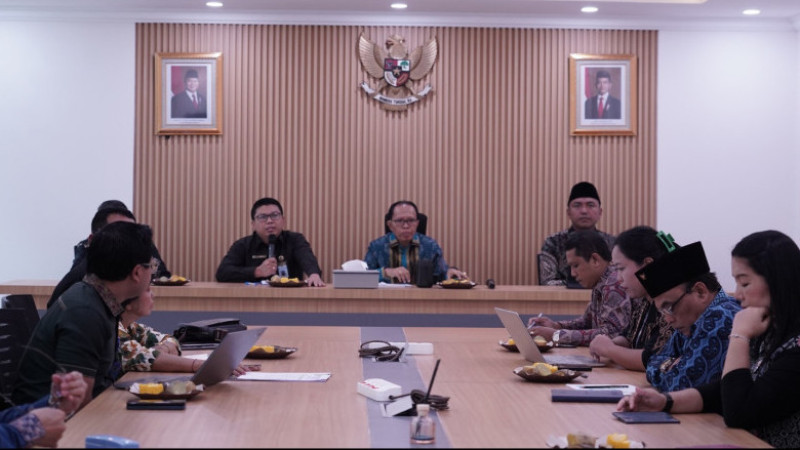
The Directorate General of Hindu Community Guidance of the Ministry of Religious Affairs officially held a coordination program entitled “Dirjen Menyapa dan Mendengar” (Buda Sanggrahana) on Wednesday. The coordination was held in a hybrid format at the 14th Floor Meeting Room of the Ministry of Religious Affairs Building on Jalan M.H. Thamrin, Jakarta, and via Zoom Meeting with regional representatives nationwide.
The agenda was attended by The Officials from second, third and fourth Echelon, Rectors or Heads of State Hindu Religious Higher Education Institutions (PTKHN), and Hindu religious counselors across Indonesia.
The main objective of the agenda was to open a direct communication channel between the central office and regional units to address various field-level issues that have not been optimally resolved. The Director General of Hindu Community Guidance, Prof. Dr. I Nengah Duija, emphasized that the agenda reflected the presence of the state in the regions through the Ministry of Religious Affairs in addressing community concerns seriously. Through an interactive discussion session, each regional representative was given the opportunity to present reports directly to central leadership.
In his remarks, Prof. I Nengah Duija introduced the tagline “Asasih Amertaning Jagad” as the overarching theme for all activities commemorating Nyepi and Dharma Santi in 2026. He instructed all civil servants, regional Hindu guidance officials (Pembimas), and religious teachers to adopt the tagline in all related activities starting immediately. The Director General also highlighted that the momentum of Nyepi, which is close to Eid al-Fitr should serve as an opportunity to strengthen interfaith harmony, in line with the guidance of the Minister of Religious Affairs.
Regarding welfare issues, the Director General provided assurance concerning the payment of the 2025 Teacher Professional Allowance (TPG) for those who passed the certification process. Although payments are currently delayed due to dynamic national budget conditions, he guaranteed that teachers’ rights would be fulfilled and calculated retroactively starting January 2026. He also reminded all parties that government assistance must be based on formal proposals—such as for houses of worship or institutions—rather than personal cash donations, in order to maintain proper financial administration.
The Director of Hindu Education, Prof. I Ketut Sudarsana, addressed technical measures related to finalizing the Technical Guidelines (Juknis) for TPG payments, particularly for Widyalaya teachers. His department is formulating an affirmative policy regarding teaching hour requirements for Widyalaya teachers assigned to remote areas, ensuring they remain eligible for their allowances. The completion of these guidelines is targeted immediately before Nyepi, therefore it can be integrated into the EMIS system.
In addition, Prof. Sudarsana is also processing the 2026 Technical Guidelines for the School Operational Assistance (BOS) program, which has undergone regulatory changes. Concerning institutional development, he encouraged regional offices to propose the establishment of new Widyalaya institutions, facilitating online visitation processes to address operational cost limitations. He further affirmed that schools affected by natural disasters would be prioritized for infrastructure assistance.
The Director of Hindu Religious Affairs, Ida Bagus Ketut Drana Arimbawa, highlighted the digital transformation of registration services for houses of worship (Pura), which now utilize Electronic Signatures (TTE). Despite challenges related to system speed, the use of TTE is expected to resolve thousands of pending registration applications nationwide. Registration certificates are crucial, as they constitute a primary requirement for religious institutions to access state and regional budget assistance (APBN and APBD).
Regarding physical assistance, an initial allocation of IDR 2 billion has been designated for disaster-affected Pura, particularly in Bali. The Directorate of Hindu Religious Affairs requested that regional offices submit beneficiary data to expedite disbursement. The Director also informed participants that the schedule for competency assessments for Hindu religious counselors is being finalized in coordination with the Human Resources Bureau to support career advancement at the regional level.
The Secretary of the Directorate General of Hindu Community Guidance, Dr. Ida Made Pidada Manuaba, outlined plans to refine the organizational structure of Hindu community guidance in various regions, including proposals to elevate the status of certain regional offices in Central Sulawesi and Southeast Sulawesi. An assessment process is also underway to fill vacant supervisory positions in regions such as Bali, East Nusa Tenggara (NTT), and Lampung, ensuring sustainable services to the community.
The Director General expressed hope that all regional units would align their efforts with central policies, maintain constructive communication with respective local governments, and focus on enhancing the spiritual quality of the Hindu community. The entire Buda Sanggrahana initiative is expected to serve as a strong foundation for a more responsive and transparent governance system within the Directorate General of Hindu Community Guidance in 2026.
Translated by Muhammad Mahmud Alhushori