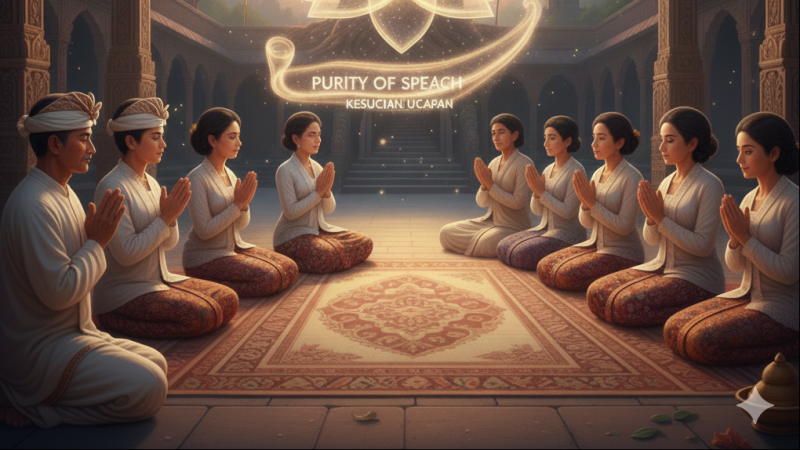
Om Swastyastu. Om Awighnamastu Namo Siddham.
This edition of Mimbar Hindu carries the theme “Wacika Parisudha: Building Hita (Harmony) Through Words.”
Om Swastyastu. Om Awighnamastu Namo Siddham.
This edition of Mimbar Hindu carries the theme “Wacika Parisudha: Building Hita (Harmony) Through Words.”
This reflection is inspired by the many communication-related conflicts that arise in our modern, globalized era. Globalization is closely tied to rapid advances in information and communication technology, which have brought countless benefits to human life. These technologies make it easier for us to learn, connect, and stay informed. Through them, we can quickly gain knowledge, follow global events, and build wider networks of friendship and cooperation. In essence, communication technology can be a powerful medium for exchanging ideas, offering support, and fostering unity.
However, this progress also brings challenges. We often witness moral decline in the way people communicate, leading to disharmony and conflict. One major concern is the spread of hate speech — whether in direct interactions or on social media. Hate speech includes insults, defamation, provocation, incitement, and the spreading of false information.
According to Infographic: Facebook Ramps Up Efforts Against Hate Speech (2020), there were 9.6 million hate speech cases recorded on Facebook that year. In Indonesia, during the first 100 days of the Virtual Police initiative (February 23 – May 31, 2021), authorities issued warnings to 215 Twitter accounts, 180 Facebook accounts, 14 Instagram accounts, and 19 YouTube channels for engaging in hate speech. Such acts, often directed at individuals or groups, create division and prevent us from achieving santih (peace) and hita (happiness).
This issue calls for us to return to the guidance of Hindu philosophy — as a moral compass for cultivating peace in the age of digital communication. One key teaching that can guide us is Wacika Parisudha, the practice of purifying one’s speech. As part of Tri Kaya Parisudha (purity of thought, word, and deed), Wacika Parisudha emphasizes the importance of speaking with kindness, sincerity, and truth.
The Power of Words
Self-awareness is the foundation of Wacika Parisudha. Every time we engage in conversation, we must learn to filter our words. Before speaking, pause and ask yourself: Will my words bring benefit or harm? Avoid harsh, cruel, or deceitful speech, for words can wound as deeply as weapons.
The Sarasamuscaya Sloka 75 reminds us:
“Nyang tanpa prawrttyaning wak, pat kwehnya, pratyekanya, ujar ahala, ujar aprgas, ujar picuna, ujar mithya, nahan tang pat singgahaning wak, tan ujarakena, tan angina-ngenan, kojarnya”
“Four kinds of speech should be avoided: evil words, harsh words, slander, and lies. These should neither be spoken nor even thought about.”
Hurtful words linger in the heart of the listener, planting seeds of anger and resentment. Sarasamuscaya Sloka 120 compares such speech to an arrow:
“Ikang ujar ahala-tan pahi lawan hru, songkabnya sakatempuhan denya juga alara, resep ri hati, tatankenengpanhan turu ring rahina wengi ikang wwang denya, matangnyat, tan inujaraken ika de sang dhira purusa, sang ahning maneb manah nira”
Meaning: “Evil speech is like an arrow once released—it causes pain wherever it lands. The wound seeps into the heart, robbing one of Peace Day and night. Therefore, the wise avoid such words.”
Our words, then, are like swords or weapons. When used wisely, they protect and uplift; when misused, they harm both others and ourselves.
The Mahabharata, in the Sabha Parwa, tells the story of Prabu Cedi Sisupala, who insulted the Pandavas, Bhisma, and Prabu Sri Kresna during the Rajasunya Yajna (royal consecration ritual). His harsh words provoked Lord Kresna’s anger, leading to his death by the divine Cakra Sudarsana. This story illustrates how reckless speech can bring one’s downfall.
Similarly, the Kakawin Nitisastra (V.3) teaches:
Through words, you may find happiness.
Through words, you may meet your end.
Through words, you may face suffering.
Through words, you may gain a friend.
Speaking with Kindness and Awareness
The habit of speaking kindly is a form of sila (moral conduct) that must be cultivated with awareness. We should train ourselves to speak words that are honest, gentle, and filled with good intention. As Sarasamuscaya Sloka 118 advises:
“Ika tang ujarakena, rahayu ta ya, haywa ta winistaraken haywa hyun-hyun kawarjana angucap, apan ikang ujar yan, jambat, hanang haras, hana ililik pinuharanya , tan rahayu tan ngaranika”.
“Speak only words that bring goodness. Do not speak merely to seek praise or admiration. Words that are excessive may please some but anger others—and that is not good.”
Based on that, we learn that building hita (harmony and happiness) through words means developing mindfulness in speech. By consistently practicing Wacika Parisudha, we avoid harmful words and nurture peace and understanding in every interaction.
My dear fellow Hindus,
Let us strengthen our commitment to unity and harmony through the noble teachings of dharma. Let us purify our words, our communication, and our intentions, aligning them with truth and compassion.
As Sarasamuscaya Sloka 2 reminds us:
“Among all living beings, only humans have the ability to perform good or bad deeds. Therefore, cleanse all bad deeds with good ones—that is the true purpose of being human.”
Through practicing kind and mindful speech, we contribute to peace (santih) both within ourselves and in the wider world. The Atharvaveda XIX.9.2 expresses this hope beautifully:
“May the past, present, and future be filled with peace and kindness toward us all.”
My dear fellow Hindus,
May this reflection serve as spiritual nourishment for us all — inspiring us to realize santih (peace) and hita (happiness) through pure and compassionate words.
Om Santih, Santih, Santih Om.
I Made Danu Tirta (Civil Servant, Ministry of Religious Affairs, Tabanan)
Kontributor: Muhammad Mahmud Alhushori
Editor: Jaya Perdhana
Ilustrator: Jaya Perdhana