
DHARMA WACANA - (English Version)
Let us begin by offering our deepest gratitude to Ida Sang Hyang Widhi Wasa, by whose boundless grace we continue to enjoy good health, safety, and the opportunity to gather.
We live in an era of extraordinary progress. Technology continues to advance at an unprecedented pace, and information now travels across the globe in a matter of seconds. Scientific and technological innovation has brought the world closer than ever before.
Yet behind these remarkable achievements lies a reality that deserves our careful reflection. People today often find it easier to quarrel, insult, and hate one another. Armed conflicts continue to erupt in various parts of the world. Differences too often become sources of division, while social media is increasingly filled with harsh words, hostility, and polarization. Brotherhood and compassion are frequently overshadowed by ego and self-interest.
Our world does not lack intelligent people. What it needs is more people with peaceful hearts.
This is why the teachings of Dharma remain profoundly relevant. In Hinduism, Dharma is far more than religion or ritual observance. It is the universal path of truth, righteousness, balance, and harmony that guides every aspect of human life.
When individuals live based on Dharma, peace naturally flourishes. Conversely, when anger, greed, and ego dominate the mind, conflict and destruction inevitably follow. World peace does not always begin with grand political agreements or powerful speeches. It begins within the human heart.
When peace resides in our hearts, it nurtures harmony within our families. Harmonious families build harmonious communities, and harmonious communities become the foundation of a peaceful world.
For this reason, Hinduism places great emphasis on self-mastery. The Bhagavad Gita teaches that humanity's greatest enemy is not another person but the uncontrolled mind. Those who cannot govern their thoughts and emotions are easily drawn into conflict.
We witness this reality every day. A single comment on social media can escalate into prolonged hostility. Differences in opinion can weaken lifelong friendships. A moment of uncontrolled anger can produce words that leave lasting emotional wounds.
Indeed, a single harsh remark may inflict pain that endures far longer than we realize.
Therefore, being mindful of what we say is an essential part of preserving peace.
Hindu teachings present the principle of Tri Kaya Parisudha, the three means of purification:
- cultivating pure thoughts,
- speaking truthful and kind words, and
- performing righteous actions.
If these principles were sincerely practiced in daily life, many conflicts could be prevented before they even begin.
Imagine a society in which every individual chooses to think positively, speak respectfully, and act compassionately. Social media would become a platform for encouragement rather than hostility. Communities would be strengthened instead of divided. Families would grow in mutual trust instead of falling into discord.
Unfortunately, today's reality often reveals the opposite. False information spreads rapidly. Slander is readily believed. Provocation is shared without careful reflection.
Yet every message we choose to share carries the power to influence the lives of others.
Before forwarding information or expressing an opinion, we should first ask ourselves:
"Will it bring peace, or will it make matters worse?"
Peace also requires us to honor diversity.
Indonesia is blessed with extraordinary cultural, ethnic, and religious diversity. We differ in language, traditions, beliefs, and perspectives. Yet diversity should never become a reason for hostility.
Hindu teaches us:
Ekam Sat Vipra Bahudha Vadanti
"Truth is One; the wise describe it in many different ways."
This timeless teaching encourages us to cultivate tolerance, mutual respect, and sincere appreciation for others.
In practical life, these values are expressed by respecting neighbors as they worship according to their own faiths, maintaining friendships across religious boundaries, and resolving disagreements through respectful dialogue rather than hatred.
Simple actions such as these become the true foundation of national unity and world peace.
Many conflicts begin with human ego—the belief that we alone are right, holier than others, or superior in every way.
Yet genuine wisdom always nurtures humility.
We often see families divided because no one is willing to yield. Friendships are broken because pride prevents people from apologizing. Even neighbors become estranged over trivial misunderstandings.
Sometimes peace begins with one simple utterance:
"I'm sorry."
Offering an apology is not a sign of defeat. Forgiving others is not a sign of weakness. On the otherside, both require great inner strength. Hinduism also teaches the principle of Ahimsa, non-violence. Ahimsa extends far beyond refraining from physical violence. It also means refusing to harm others through words, attitudes, or actions.
Today, many people never show violence to another person physically, yet they inflict deep wounds through insults, humiliation, and hateful comments. However, emotional wounds can often take far longer to heal than physical injuries.
Therefore, strive to become someone who brings calm rather than fear. Begin with simple acts of kindness. When another driver makes a mistake, respond with patience instead of anger. When a colleague errs, offer guidance instead of humiliation.
The same principle applies within the family. Children raised with love and compassion are more likely to become adults who contribute to peace. For that reason, protecting world peace begins at home.
The world also needs compassionate people. Peace cannot flourish where selfishness prevails.
Helping disaster victims is an expression of Dharma. Caring for the sick is an expression of Dharma. Protecting the environment is equally an expression of Dharma.
Hindu philosophy teaches Tri Hita Karana, the three causes of well-being:
- harmony between humanity and God,
- harmony among human beings, and
- harmony between humanity and nature.
When nature is exploited through greed, the balance of life is disrupted. Floods, pollution, and environmental degradation often result from humanity's disregard for this sacred relationship.
Protecting nature, therefore, is also an act of preserving peace. Young people have a vital role in shaping a more peaceful world.
Use social media to spread inspiration rather than provocation. Create content that strengthens unity instead of sowing division. One positive message can inspire countless people, just as one hateful statement can wound many hearts. Be a generation that is digitally wise and morally grounded.
World peace is never born from hatred.
It grows through compassion, self-control, tolerance, and genuine concern for others.
Let us begin with simple actions:
Smile at others, express gratitude, avoid hurtful words, listen with empathy, and respect every difference.
The world does not need more hatred. It needs more people whose hearts are filled with peace.
In closing, let us strive to become individuals who bring peace wherever we go.
Do not become the source of conflict.
Do not become a spreader of hatred.
Instead, become a bearer of serenity.
May the teachings of Dharma continually guide our lives, strengthen our brotherhood, deepen our respect for diversity, and inspire us to build a more peaceful world.
For true world peace begins with peace within the human heart.
Let us conclude with the Puja Parama Shanty.
Om Śāntiḥ, Śāntiḥ, Śāntiḥ Om.
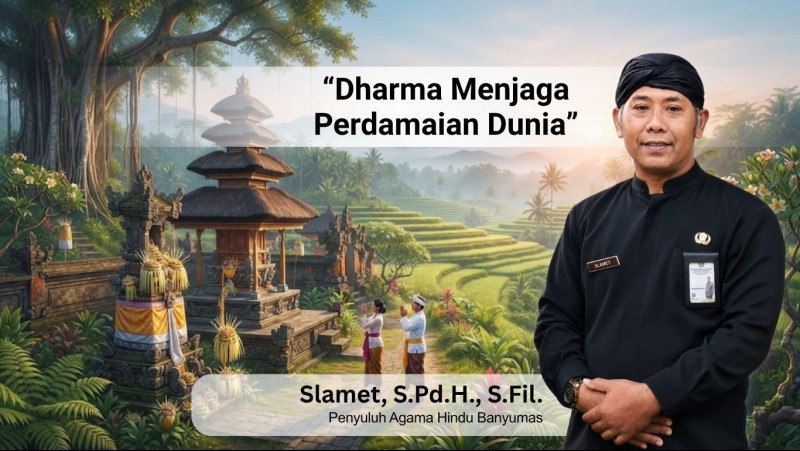
Author: Slamet, S.Pd.H., S.Fil.
Hindu Religious Counselor, Banyumas