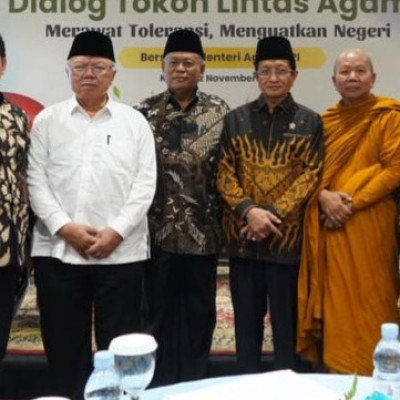

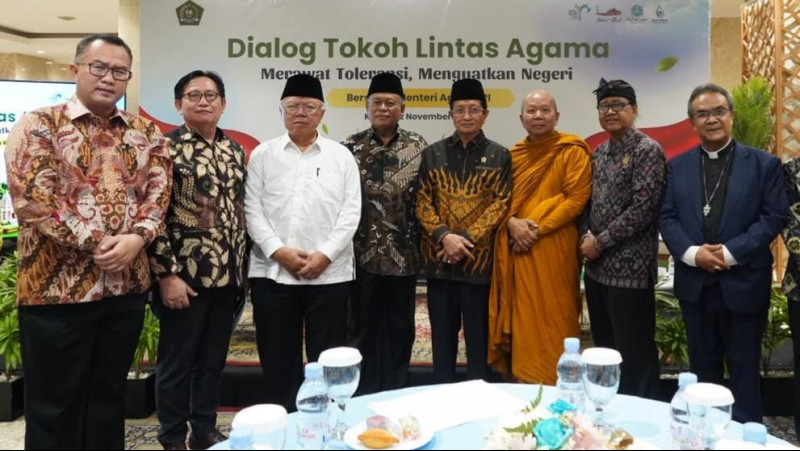
Interfaith leaders have issued a joint statement emphasizing the importance of preserving religious harmony and upholding national sovereignty. The seven-point declaration was delivered by representatives of various religious communities during the Interfaith Leaders’ Dialogue at Masjid Istiqlal in Jakarta.
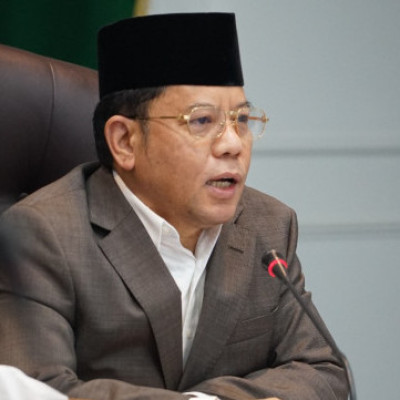
Minister of Religious Affairs Nasaruddin Umar said the dialogue was attended by approximately 100 participants, with representatives of Islam, Protestant Christianity, Catholicism, Hinduism, Buddhism, and Confucianism serving as speakers. Participants from different faith communities shared their perspectives and reaffirmed their commitment to maintaining social stability and strengthening solidarity within society.
“We have just held an interfaith dialogue attended by approximately 100 participants. Representatives of all religions were present as speakers, and the event also featured a joint statement by interfaith leaders entitled ‘Preserving Religious Harmony, Upholding National Sovereignty,’” the Minister said at a press conference following the dialogue at Istiqlal Mosque in Jakarta on Thursday (November 12, 2026).
Nasaruddin explained that the seven-point joint statement serves as a moral foundation for religious communities to continue safeguarding peace, harmony, and social cohesion. Through the declaration, interfaith leaders reaffirmed their shared commitment to upholding the fundamental principles of the Republic of Indonesia (NKRI).
He added that religious communities were also encouraged to exercise self-restraint and patience, and to pursue collective efforts when responding to various issues arising in society. A calm and measured approach, he said, is essential to addressing national challenges in a mature and constructive manner.
“All religious communities have agreed to remain committed to upholding the fundamental principles of the Republic of Indonesia. We are also encouraged to exercise self-restraint when responding to various issues that may arise around us and to reconnect with the sacred teachings of our respective religions, which are fundamentally rooted in love, friendship, and peace,” the Minister said.
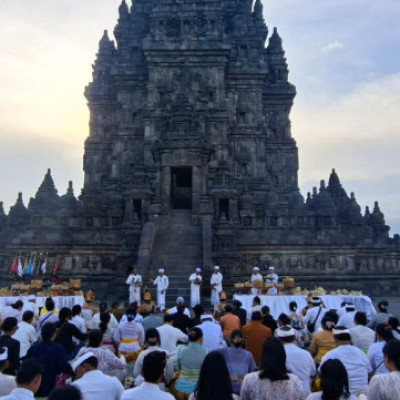
Nasaruddin further emphasized that efforts to promote tolerance must extend beyond dialogue forums and be followed by coordinated action at every level of the Ministry of Religious Affairs. On the same day, the Ministry mobilized its provincial regional offices, regency and municipal offices, Religious Affairs Offices (KUA), and mosques throughout Indonesia to organize collective prayers and thanksgiving gatherings.
This nationwide initiative represents a spiritual effort to seek strength and resilience for Indonesia in facing global developments and challenges, including the effects of uncertainty in the global economy.
“We pray that the global difficulties facing nations, particularly Indonesia, will be lifted by Almighty God, so that prosperity and peace may once again prevail for families and all living beings,” the Minister said.
Furthermore, the prayers for economic resilience and public prosperity, the gatherings also provided an opportunity to express gratitude for the continued preservation of national unity. Nasaruddin noted that various national challenges and potential conflicts had been prevented at an early stage or addressed through corrective measures within the constitutional framework. He said this reflected Indonesia’s growing maturity in safeguarding democracy and national unity.
The Minister also called on the public to combine practical efforts with spiritual approaches, including prayer and gratitude, in responding to the challenges facing the nation.
Seven-Point Joint Statement of Interfaith Leaders
The following seven-point joint statement was delivered during the Interfaith Leaders’ Dialogue at Istiqlal Mosque by representatives of different religious communities: Rev. Dr. Ir. Hano Abinasti Palit, M.Th. (Protestant Christianity); Budi S. Tanuwibowo (Confucianism); Dr. KH. Marsudi Syuhud (Islam); R.D. Aloysius Budi Purnomo (Catholicism); KRHT P. Astono Chandra Dana, S.E., M.M. (Hinduism); Venerable Bhikkhu Wongsin Labhiko Mahathera (Buddhism); and Arif Satria, Chairman of the Indonesian Association of Muslim Intellectuals (ICMI).
1. Reaffirm our national commitment that the Unitary State of the Republic of Indonesia (NKRI) stands firmly upon the foundation of Belief in the One and Only God, which serves as the spiritual basis for social, national, and state life.
2. Honor the sacrifices and fighting spirit of the nation's heroes, who gave their lives and devoted their strength to securing, defending, and fulfilling the promise of independence.
3. Preserve the spirit of nationalism and patriotism through unity, brotherhood, and tolerance, while rejecting all forms of anarchic action and any attempts to divide society or undermine national sovereignty.
4. Uphold religious harmony, social cohesion, and interfaith brotherhood as essential foundations and prerequisites for sustainable national development, while maintaining a peaceful and conducive atmosphere amid national and global developments.
5. Put the noble values of religion into practice as a source of moral guidance, public ethics, and unifying strength for communities across Indonesia's diverse society.
6. Encourage all religious communities and the wider public to exercise sound judgment and remain vigilant against provocation by verifying and clarifying information before responding to developments circulating on social media.
7. Reject all forms of exploitation and environmental destruction as part of our shared responsibility to protect nature, while supporting development policies aimed at achieving prosperity and social justice for all Indonesians.
The joint statement reflects the shared commitment of Indonesia's religious communities to preserving national unity, strengthening interfaith solidarity, and safeguarding the country's sovereignty. Through continued dialogue, mutual respect, and cooperation, religious leaders hope to ensure that the values of peace, justice, and humanity remain central to Indonesia's national life.
Author : I Made Juni Saputra
Photographer : I Gusti Ngurah Sathya Dharma