
HINDU RELIGIOUS ARTICLE (ARTIKEL HINDU)
Amid the rapid currents of globalization and technological development, Hindus face significant challenges. Modernization has brought many conveniences, but it also has the potential to erode the spiritual values, cultural traditions, and religious identity inherited from previous generations. In such circumstances, Dharma acts as a compass, guiding Hindus to remain steadfast in living a life rooted in truth, virtue, and harmony.
The province of North Sumatra offers a real example of the diversity within Indonesia's Hindu community. A significant proportion of Hindus in the province come from the Tamil Indian community, whose religious life is deeply rooted in traditions of bhakti, puja, homam, temple celebrations, and various social and religious activities. At the same time, the Karo Hindu community continues to preserve a rich ancestral heritage grounded in spiritual values, reverence for ancestors, and cultural wisdom passed down through generations.
Although these communities have different cultural backgrounds, they are united by one noble purpose: to practice Dharma in their daily lives.
Viewed from Hindu teachings, Dharma is not merely a set of religious rules or obligations. It is the foundation of life that maintains balance among humanity, nature, and God. Therefore, diversity should never become a reason for division. Instead, it should serve as a source of strength through which communities complement and enrich one another.
Sri Rama: An Example of Leadership Rooted in Dharma
This principle is beautifully reflected in the story of Sri Rama, as recounted in the Itihasa Ramayana. Sri Rama is known as Maryada Purushottama, the ideal human being and an exemplary figure in the practice of Dharma.
Once his rightful position as crown prince was deprived, Sri Rama did not respond with rebellion or anger. Instead, he accepted fourteen years of exile in order to honor his father, King Dasaratha, and faith the truth.
Sri Rama's sacrifice teaches that true leadership emerges from self-control, sincerity, and the willingness to place the greater good above personal interests. He did not lead through power alone, but through exemplary conduct that inspired everyone around him.
This teaching is consistent with Bhagavad Gita III.21:
Yad yad acarati sresthas tat tad evetaro janah,
Sa yat pramanam kurute lokas tad anuvartate.
Meaning:
“Whatever a noble person does, others follow. Whatever standard they establish through their example, the world follows.”
This sloka reminds us that leaders, religious figures, parents, teachers, and all individuals respected by society have a moral responsibility to serve as role models. In the context of the Hindu community in North Sumatra, this teaching is particularly relevant to community leaders, temple administrators, Hindu Religious Counselors, and all members of society who have a responsibility to demonstrate unity, tolerance, and sincere service to the community.
Lessons from the Mahabharata
The Ramayana is not the only Hindu epic that offers profound lessons on upholding Dharma amid life's challenges. The Mahabharata also provides valuable teachings on the importance of remaining committed to truth and righteousness.
Yudhishthira is renowned for his extraordinary honesty and integrity. Even when faced with suffering, exile, and various forms of injustice, he remained steadfast in upholding the truth. Vidura, meanwhile, represents wisdom and the courage to speak the truth, even when his advice was often ignored.
Their stories teach us that true success is not measured solely by power, position, or wealth, but by a person's ability to uphold the values of Dharma in every decision and circumstance.
The Mahabharata demonstrates that when greed and ego dominate human life, destruction follows. Conversely, when honesty and wisdom serve as the foundation of action, peace and prosperity can be achieved.
Passing Dharma on to the Younger Generation
These noble teachings are especially important to pass on to the younger generation of Hindus. In the digital era, where children and young people are exposed to unlimited information and diverse influences, they need exemplary figures who can guide them while helping them remain rooted in religious values.
The stories of Sri Rama, Yudhishthira, Hanuman, and other noble figures are not merely tales from the past. They remain valuable sources of character education that continue to be relevant across generations.
For the Hindu community of North Sumatra, the spirit of Dharma must be expressed through a strong sense of brotherhood among Tamil Hindus, Karo Hindus, and all other Hindu communities. Differences in language, customs, and ritual traditions should be viewed as a cultural wealth that enriches religious life.
Just as a rainbow is beautiful because of the diversity of its colors, the Hindu community becomes stronger when it is able to remain united amid diversity.
Unity Through Exemplary Conduct and Service
It is in this spirit that the teachings of Sri Rama remain deeply relevant today. He demonstrated that unity is built through exemplary conduct, sacrifice, compassion, and respect for others.
When these values are practiced in community life, Hindus can not only preserve their religious identity but also become a moral force that contributes positively to the nation and the state.
Ultimately, the strength of the Hindu community is not determined by its quantity, but by the quality of its practice of Dharma. When every Hindu makes Dharma the foundation of thought, speech, and action, a religious, harmonious, culturally grounded, and compassionate society can emerge.
Let us follow the example of Sri Rama by strengthening the bonds of brotherhood, reinforcing harmony between Tamil Hindus and Karo Hindus, and making North Sumatra a living example of how diversity grounded in Dharma can give rise to peace, progress, and happiness for all.
Dharmo Rakshati Rakshitah
Dharma protects those who protect Dharma.
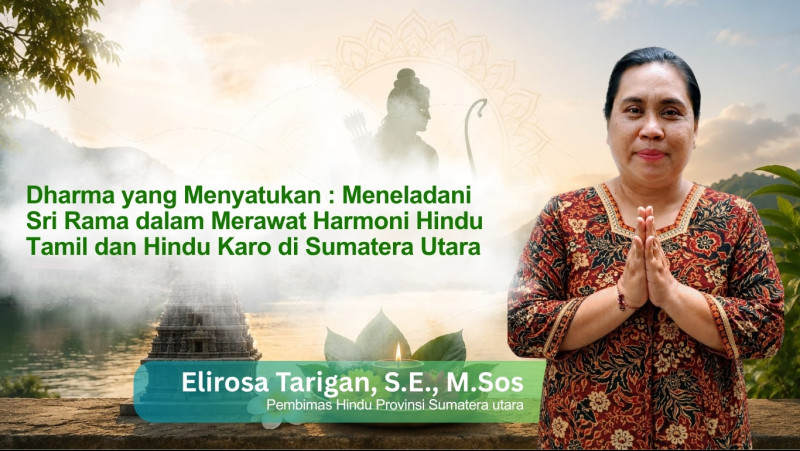
Author : Elirosa Tarigan, S.E., M.Sos.
(Hindu Religious Counselor at Ministry of Religious Affairs Regional Office of North Sumatra Province)
Editor : I Made Juni Saputra