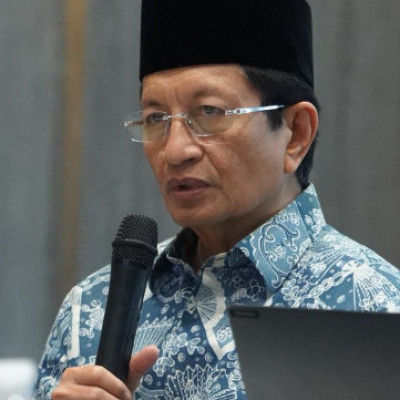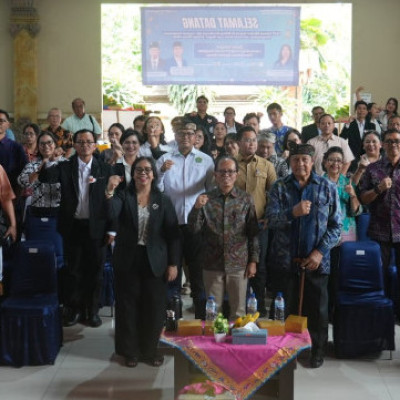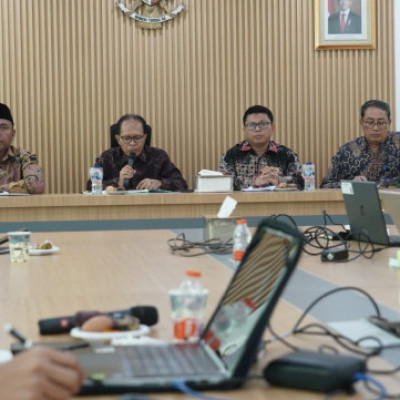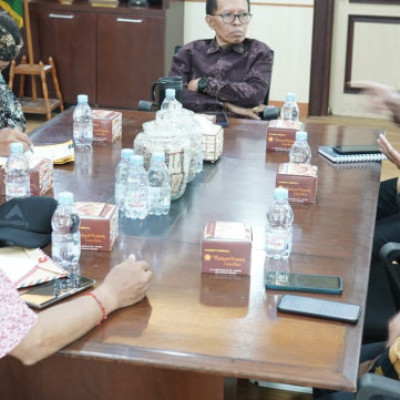

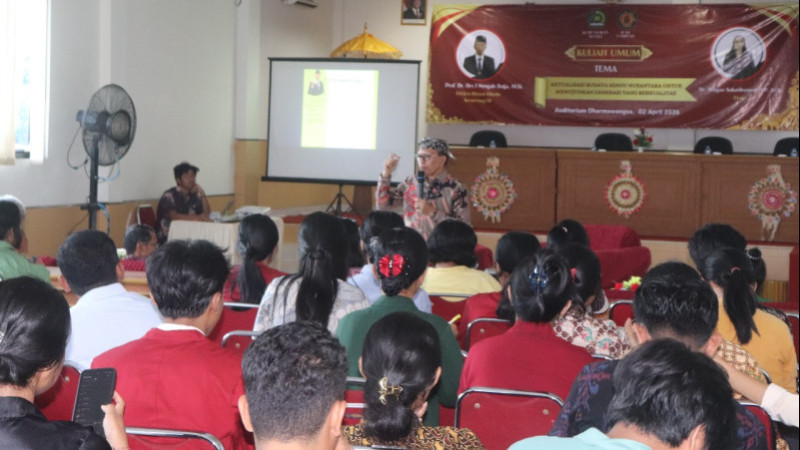
The Director General of Hindu Community Guidance at the Ministry of Religious Affairs of the Republic of Indonesia, Prof. Dr. Drs. I Nengah Duija, M.Si., delivered a public lecture toward dozens of students and lecturers at the State Hindu College (STAH) Lampung on Thursday which was held at the Dharmawangsa Auditorium. Prof. Duija presented an in-depth topic titled “Aktualisasi Budaya Hindu Nusantara untuk Mewujudkan Generasi Berkualitas”
The agenda was moderated by Dr. Wayan Sukarlinawati. Prof. Duija emphasized that the strength of Hinduism in Indonesia lies in the diversity of its traditions, which are able to absorb local identities without losing their spiritual essence. He reminded the audience that Nusantara Hinduism is not a rigid standard, but rather a harmony of various cultural expressions, ranging from Javanese and Balinese Hinduism to traditions in Lampung.
“Religion has ethical standards and substantive standards. The substantive standard is Panca Sradha. Whatever we read from scriptures, the line of thought regarding Nusantara traditions before Islam is almost entirely similar,” said Prof. Duija in his address.
He also explored the history of Hindu literacy, explaining that many normative practices currently observed in Bali actually originate from Javanese literary traditions between the 9th and 14th centuries. However, Prof. Duija offered a critical note on the phenomenon in which tradition is sometimes emphasized more than the substance of the religion itself.
He cited the example of the Ogoh-ogoh tradition, which only became popular around 1979 but now seems to be considered an essential part of Nyepi celebrations, even though the true substance of Nyepi lies in self-restraint.
“Tradition is a practice carried out consistently for at least three generations, thus becoming a tradition. What we are concerned about is that tradition should not shift the implementation of the substance of religion. Nyepi is simple, yet the Ogoh-ogoh is extravagant,” he stressed.
Furthermore, Prof. Duija highlighted the challenges posed by rationality and technology in religious life. He adds that cultural and technological developments are inevitable, such as the use of mobile phones to monitor rituals or discussions about efficiency in ceremonies. Nevertheless, he reminded that religion should not be reduced solely to rationality, as its foundation is belief (revelation).
The public lecture concluded with a profound reflection on the limitations of human knowledge. Prof. Duija shared an analogy of a scientist who realizes that no matter how advanced technology becomes, it cannot restore life—at which point faith in God becomes absolute.
Through this lecture, it is hoped that the younger generation of Hindus in Lampung will become individuals of high quality, capable of wisely distinguishing between adaptive cultural dynamics and the essential substance of religious teachings that must be preserved in their purity.
Translated by Muhammad Mahmud Alhushori