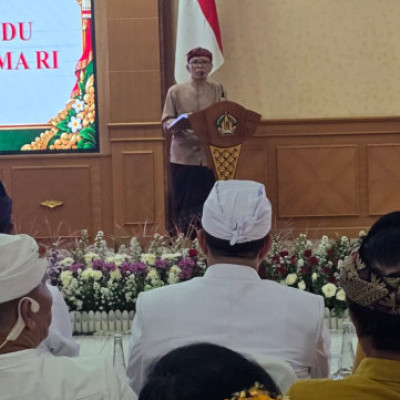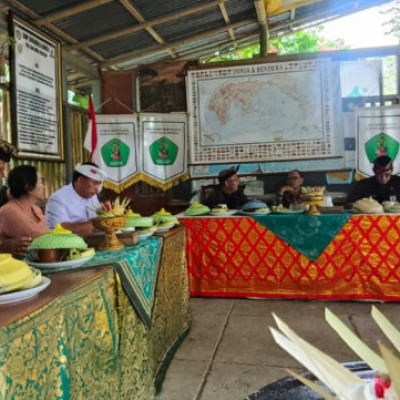

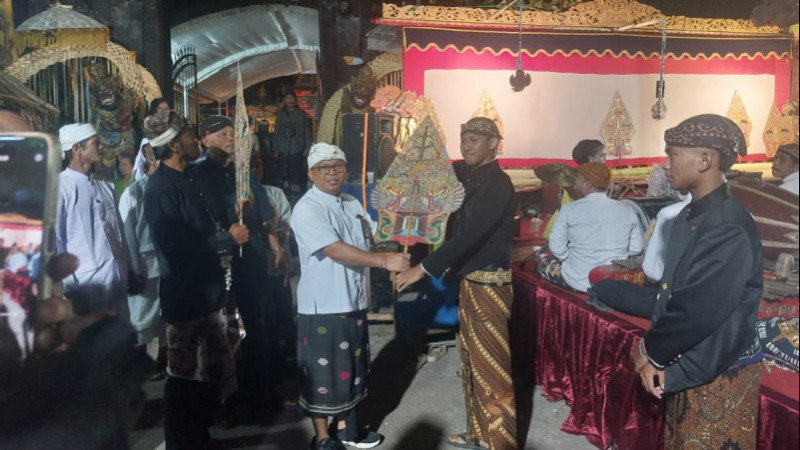
Hindus are encouraged to deepen their spiritual lives through control of the mind, the practice of yoga, and the preservation of Hindu civilization's heritage on Mount Wilis. The message was delivered by Secretary of the Directorate General of Hindu Community Guidance, Dr. Ida Made Pidada Manuaba, during a Dharma Wacana at the 25th anniversary temple festival (Piodalan) of Pura Kerta Bhuwana Giri Wilis in Nganjuk Regency, East Java, on Sunday (October 25, 2026).
Representing the Director General of Hindu Community Guidance, Dr. Ida Made Pidada Manuaba delivered the discourse in conjunction with the full moon of the fifth lunar month (Purnama Kalima) at Pura Kerta Bhuwana Giri Wilis, located in Kampung Adat Curik Hamlet, Bajulan Village, Loceret District. The event was attended by representatives of the East Java Governor and the Nganjuk Regent, including officials from the respective regional agencies for national unity and public order, as well as regional government representatives, the Hindu Community Guidance Office, religious leaders, respected elders, and members of the Hindu community.
During his Dharma Wacana, he encouraged the community to recognize Mount Wilis as an area of historical and spiritual significance in the development of Hindu civilization in Java. According to the material he presented, the mountain has been regarded as sacred since the era of the Hindu Mataram Kingdom through the Majapahit period.
“From the era of the Hindu Mataram Kingdom to the Majapahit period, Mount Wilis was already regarded as a sacred mountain,” Dr. Ida Made Pidada Manuaba said.
He also discussed local traditions connecting Mount Wilis with several prominent figures in Javanese history. Prabu Jayabaya is associated with meditation at Sedudo Waterfall, Patih Gajah Mada with ascetic practices at Ngliman, and Prabu Brawijaya with spiritual practices in Bajulan.
His Dharma Wacana also highlighted the Penampihan Temple Complex as an important historical heritage site in the Mount Wilis area. The presentation referred to discoveries of Ganesha statues dating from several kingdom periods as evidence used to illustrate the continuity of spiritual activities in the region.
These historical values were linked to the importance of spiritual ascent in Hindu tradition. The presentation described the spiritual journey as an effort to purify the body, mind, and atma (the spiritual self) through tapa brata (ascetic discipline), yoga, and samadhi (deep meditative absorption).
Turning to the teachings of yoga, Dr. Ida Made Pidada Manuaba emphasized the importance of mastering the fluctuations of the mind. He referred to Yoga Sutra I.2, presented in his materials as “Yoga’s Citta Vritti Nirodhah.”
“Yoga is the practice of controlling or stilling the waves of the mind,” he explained.
Mastering the mind is essential to cultivating inner peace and clarity in one's actions. Through consistent practice, Hindus are encouraged to manage their desires, exercise control over their senses, and make decisions guided by the values of Dharma.
The Dharma Wacana also explained the four paths of yoga, known as Catur Yoga: Karma Yoga, Bhakti Yoga, Jnana Yoga, and Raja Yoga. These complementary paths were explained through different approaches to spiritual realization, including selfless action and service to God, devotion to God, the pursuit of spiritual knowledge, and the discipline of the mind to attain spiritual union with the Divine.
Together, these four paths illustrate how Hindu teachings can be practiced through various forms of devotion and service. Sincerity in one's work, deepening devotion, pursuing knowledge, and cultivating mental discipline all contribute to spiritual growth in everyday life.
The community was also introduced to the eight limbs of yoga: yama, niyama, asana, pranayama, pratyahara, dharana, dhyana, and samadhi. These stages encompass moral discipline, the cultivation of positive habits, the regulation of posture and breathing, control of the senses, concentration, meditation, and the deepening of spiritual awareness.
Understanding these stages of yoga is expected to go beyond theoretical knowledge and encourage their practical application in daily life. Self-discipline, perseverance, and commitment to one's responsibilities are integral to putting religious teachings into practice.
The 25th Piodalan of Pura Kerta Bhuwana Giri Wilis served as an opportunity to strengthen spiritual devotion while preserving religious traditions and ancestral heritage. Through the Dharma Wacana, Hindus were encouraged to balance ritual observances with mental discipline and the practice of Dharma, allowing religious values to guide them in fostering harmony with Ida Sang Hyang Widhi Wasa, fellow human beings, and the natural environment.
Editor : I Made Juni Saputra
Photographer : I Gusti Ngurah Sathya Dharma