
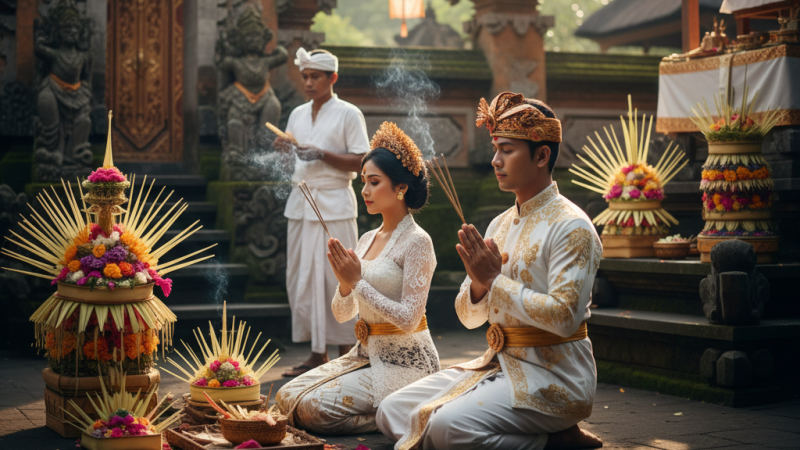
Buda Keliwon Pegatuwakan is one of the sacred days which has great significance in the Hindu religious calendar, especially for Hindus in Bali. This sacred day is observed as a moment of self-purification, both physically and spiritually, while fostering spiritual balance between human beings, nature, and God.
Etymologically, Buda Keliwon Pegatuwakan occurs at the convergence of Buda (Wednesday), the Keliwon day in the wewaran cycle, and the Pegatuwakan wuku. This combination is believed to possess strong spiritual potency, making it an auspicious time for Hindus to perform various religious rituals aimed to purify negative elements within oneself and the surrounding environment.
Generally, in this sacred day Hindus offer prayers at family shrines (sanggah or merajan), temples, and other sacred places. The rituals are accompanied by offerings such as banten pejati, canang, and other ceremonial items prepared in accordance with the principle of desa kala patra—the appropriateness of place, time, and circumstance. In addition, many Hindus perform the melukat ritual as a symbolic act of purification, intended to cleanse the body and mind from negative influences, impure thoughts, and imbalanced energies.
Buda Keliwon Pegatuwakan is also regarded as an appropriate time for self-introspection. Hindus are encouraged to reflect on their actions, words, and thoughts, and to realign their conduct with the teachings of Dharma. This practice is in harmony with the concept of Tri Kaya Parisudha, which emphasizes purity in thought, speech, and action.
Viewed from Hindu philosophical perspective, this sacred day does not focus solely on the purification of the individual (bhuana alit), but also on harmonization with the universe (bhuana agung). Harmony between humanity and nature is a fundamental principle in Hindu teachings, as reflected in the concept of Tri Hita Karana, which underscores balanced relationships between human beings and God, among human beings, and with the natural environment.
Living in the pressures and fast-paced demands of modern life, the commemoration of Buda Keliwon Pegatuwakan serves as an essential reminder for Hindus to restore spiritual balance. The rituals and prayers offered on this day are expected to bring inner peace, strengthen sraddha (faith) and bhakti (devotion), and cultivate awareness of the importance of living in accordance with religious values.
During Buda Keliwon Pegatuwakan, Hindus are encouraged not only to perform rituals physically, but also to internalize the spiritual meanings they contain. Therefore, the sacred day becomes a means of continuous spiritual cultivation, shaping individuals with principled, harmonious, and firmly grounded in Dharma.