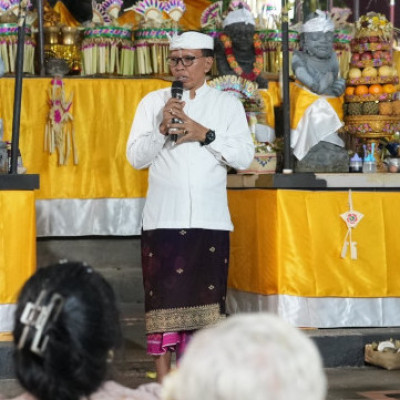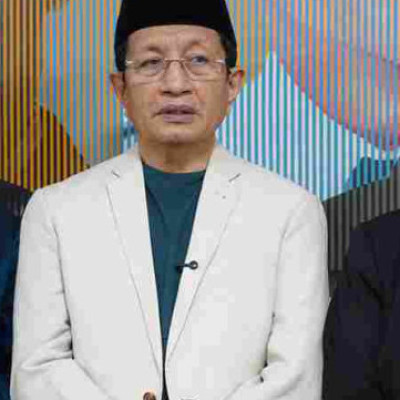


Director General of Hindu Community Guidance at the Ministry of Religious Affairs, Prof. I Nengah Duija, has emphasized the importance of making ethics and the values of Dharma the foundation of scientific knowledge. Without moral responsibility, he warned, knowledge can become a threat to human life and the continuity of civilization.
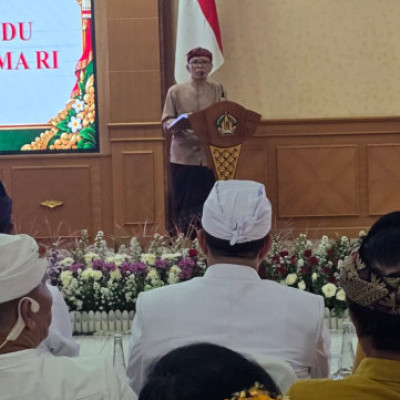
He delivered the message on his Dharma Wacana marking the Holy Day of Saraswati and the 94th Pujawali anniversary of Pura Adhitya Jaya in Rawamangun, East Jakarta, on Saturday (October 31, 2026).
Held under the theme “Dengan Sraddha dan Bhakti, Meneguhkan Dharma untuk Mewujudkan Keharmonisan, Kemandirian Ekonomi dan Kedamaian,” the event provided an opportunity to deepen the Hindu community’s understanding of the importance of grounding knowledge in moral and spiritual values.
In his message, Prof. Duija highlighted the challenges posed by scientific advancement and the rapid flow of information in the digital era. He noted that easier access to information must be accompanied by the ability to distinguish truth from falsehood and a strong sense of responsibility in using knowledge.
“Knowledge must be guided by ethics. Without ethics, knowledge can actually destroy our civilization. However, ethics without knowledge also lacks legitimacy when we speak about truth,” he said.
To illustrate this principle, Prof. Duija drew on the stories of the three disciples of Sage Dhaumya—Aruni, Upamanyu, and Veda—as recounted in the Adi Parwa. Their experiences illustrate a learning process that demands not only intelligence but also dedication, discipline, loyalty, and responsibility.
The story of Aruni teaches the importance of dedication in carrying out a teacher’s instructions. When the embankment he had built in a rice field failed to hold back the rising water, he used his own body to block the breach. His action reflects a disciple’s loyalty and sense of responsibility toward the task entrusted to him.
Meanwhile, Upamanyu’s journey offers lessons in perseverance, discipline, and self-control. The various trials he encountered demonstrate that acquiring knowledge requires patience and a willingness to undergo each stage of the learning process.
The story of Veda and his disciple, Uttanka, highlights the importance of trust, loyalty, and integrity in the relationship between teacher and student. These values are essential to an educational process that seeks not only academic achievement but also character development.
Prof. Duija stressed that education must do more than produce individuals who possess knowledge and intellectual abilities. It must also shape character and integrity, ensuring that the knowledge people acquire is applied responsibly and brings benefits to society.
“Ethics must truly serve as a guiding principle for anyone seeking knowledge in this world. We must never pursue knowledge through improper means or in ways that contradict the principles entrusted to us,” he said.
He also reminded the Hindu community that the Holy Day of Saraswati should not be limited to religious ceremonies and the symbolic veneration of knowledge. The observance must also inspire greater dedication to learning, respect for knowledge, and the practical application of what has been learned in everyday life.
According to Prof. Duija, knowledge, religion, and art are three complementary elements that contribute to human well-being. Knowledge makes life easier, religion provides direction and guidance, while art cultivates sensitivity and refinement of character.
“Knowledge makes life easier, religion gives life direction, and art refines life,” he explained.
Through the observance of Saraswati, the Director General encouraged Hindus to understand knowledge not merely as a means of developing intellectual abilities but also as a responsibility to uphold truth and humanity. The pursuit of knowledge, when guided by ethics, integrity, and the practice of Dharma, provides an essential foundation for shaping individuals of strong character and building a dignified civilization.
Editor : I Made Juni Saputra
Photographer : I Gusti Ngurah Sathya Dharma