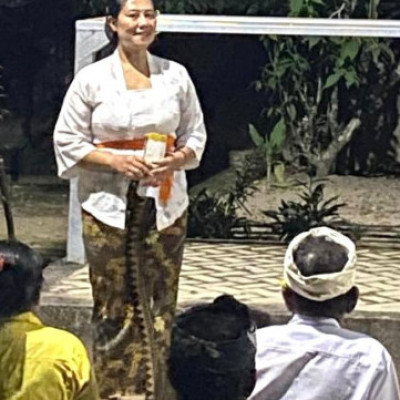


Hindus celebrate Saraswati Day, also known as Vasant Panchami or Saraswati Puja which observed every six months on Saniscara (Saturday) Umanis Wuku Watugunung according to the Balinese calendar. In Balinese Hinduism, which has developed uniquely within Indonesian culture, Saraswati holds a very special place. The celebration of Hari Saraswati marks the day when knowledge descends to the world, reminding Hindus of the sacred duty to seek wisdom and use it for goodness and harmony.
According to Hindu legend, Saraswati is depicted as the Goddess or wife of the God Brahma. She is the protector and bestower of knowledge, consciousness (widya), and literature. Thanks to the blessings of Goddess Saraswati, humans become knowledgeable, cultured, and civilized. Saraswati is often portrayed as a goddess sitting on a lotus flower, riding a swan (hamsa) or peacock. She has four arms holding a sitar or veena and a gayatri in her right hands, while her left hands hold a manuscript or book and play the veena.
In the concept of Tri Murti in Hinduism, Sang Hyang Aji Saraswati is the Shakti (divine energy) of Sang Hyang Brahma. She is portrayed as a beautiful woman with four hands, each holding sacred symbols — a vina (musical instrument) and a lotus bud in her front hands, and a genitri (rosary) and palm-leaf manuscript (cakepan) in her rear hands. She is often accompanied by a peacock and a swan, representing beauty and wisdom.
Rituals and Activities
The day begins early with offerings and prayers at homes, temples, and schools. Students and teachers gather to pray together, thanking Saraswati for the gift of learning. Special offerings called banten Saraswati are placed on books, desks, and libraries.
Many schools in Bali conduct special ceremonies in their compounds. It is a day of reflection and gratitude—no studying or reading is done after the rituals because the books are symbolically “resting” and being purified.
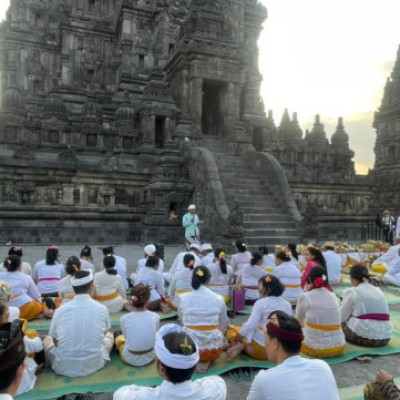
In temples, priests lead prayers and recitations of holy texts, such as the Vedas and Lontar Weda Saraswati. The community dresses in traditional white clothing, symbolizing purity and clarity of mind.
The most essential thing of Saraswati Day is not merely to commemorate the descent of divine knowledge, but to reflect on how we have applied the knowledge we possess — whether it has truly elevated our spiritual quality and contributed to the happiness and well-being of others.
The Celebration of Saraswati Day
On the day of celebration, books, scriptures, lontar (palm-leaf manuscripts), and educational tools are honored as representations of Saraswati. Balinese people believe that knowledge is a divine blessing, so it must be respected and not misused.
Banyu Pinaruh: The Day After Saraswati
The following morning, known as Banyu Pinaruh, is also deeply meaningful. People go to the sea, rivers, or springs to bathe and purify themselves, symbolizing the cleansing of the body and mind. “Banyu” means water, and “Pinaruh” comes from “pinaur,” meaning knowledge—together signifying the act of purifying oneself to receive wisdom.
Philosophical Meaning
Saraswati Day teaches that knowledge is sacred and must be guided by dharma (righteousness). True wisdom is not only intellectual understanding but also spiritual insight. Balinese Hindus believe that without knowledge, humans would live in darkness; therefore, Saraswati brings enlightenment and clarity. The celebration of Saraswati in Indonesian Hinduism reflects the deep integration of spirituality, education, and daily life. It reminds people to be humble in seeking knowledge, to use it for harmony, and to always purify their thoughts and actions. Saraswati is not just a festival—it is a spiritual reminder that learning is a sacred path toward enlightenment.
Kontributor: Muhammad Mahmud Alhushori
Editor: Jaya Perdhana
Ilustrator: Jaya Perdhana