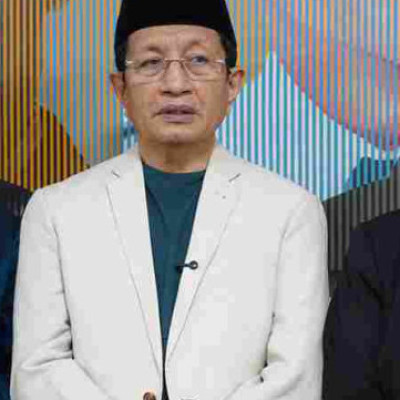

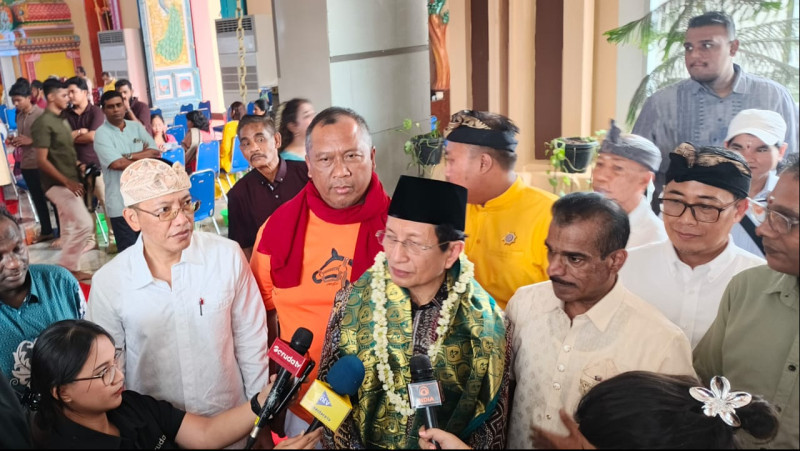
The Minister of Religious Affairs Nasaruddin Umar has called on Hindus to make Deepavali an opportunity to illuminate their inner selves, purify their minds, and uphold truth in their daily lives. He emphasized that the light celebrated during Deepavali should not be expressed solely through the beauty of lamps and decorations but should also be reflected in people's conduct and spiritual well-being.
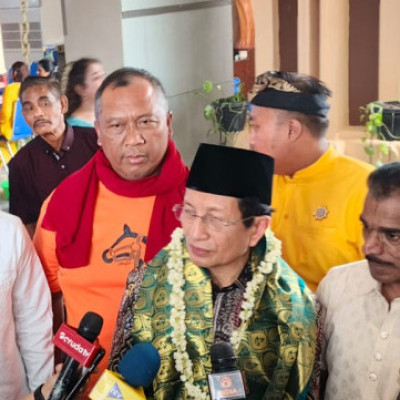
The Minister delivered the message while attending the Deepavali celebration at Shri Sanathana Dharma Aalayam, also known as Jakarta Murugan Temple, in West Jakarta, on Sunday (November 8, 2026). Organized by the Central Executive Board of the Sanathana Dharma Nusantara Community Movement (Gema Sadhana), the celebration carried the theme “The Meaning of Deepavali: The Triumph of Dharma over Adharma.”
In his remark, Nasaruddin explained that the word Deepavali derives from Deepa, meaning light or lamp, and Avali, meaning a row or series. This philosophy conveys the message that the light illuminating places of worship should also bring enlightenment to the inner lives of human beings.
“Let us not stop at illuminating these spaces or admiring the beauty of their colorful lights. The light within this place of worship must also illuminate the beauty within our hearts. It must bring enlightenment to our inner selves and our minds,” the Minister said.
He noted that the message of Deepavali is particularly relevant in today's post-truth era, when the distinction between truth and falsehood is becoming increasingly difficult to discern. This situation, he explained, can influence how people perceive and judge things, particularly under the influence of money, social media, and political interests.
“In today's post-truth era, truth and falsehood can sometimes be difficult to distinguish. Likewise, it can be difficult to distinguish Dharma from Adharma,” he said.
Nasaruddin encouraged religious community to remain committed to truth and avoid being swayed by various interests that can distort their judgment. He drew a parallel between the Hindu concepts of Dharma and Adharma and the Islamic concepts of al-haqq (truth) and al-batil (falsehood).
“Islam has similar concepts: al-haqq, which corresponds to Dharma, and its opposite, al-batil, which corresponds to Adharma. This shows that the fundamental principles underlying our religious beliefs are very closely connected,” he explained.
The Minister also highlighted the importance of houses of worship as places for reflection and self-improvement. He described them as spaces where people can strengthen their spiritual lives, straighten their thoughts, and cleanse their hearts of negative qualities.
“A house of worship is a spiritual workshop—a place to straighten our thoughts when they have gone astray, soften our hearts when they have become hardened, and purify our inner selves when they have become clouded,” he said.
Nasaruddin also commended the Hindu community in Indonesia for maintaining harmony between religious life and national identity. He encouraged people of all faiths to strengthen bonds of brotherhood by embracing humanitarian values, mutual respect, and compassion across religious differences.
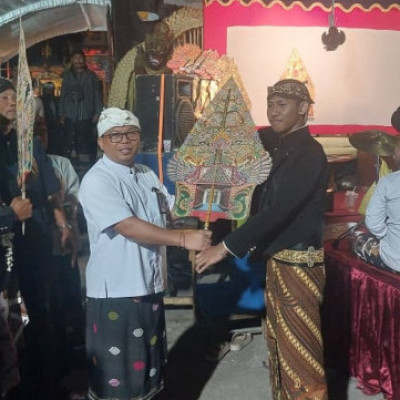
During the celebration, the Minister received Catur Veda, presented by Gema Sadhana Chairman A.S. Kobalen. The sacred compilation consists of four Vedas: the Rigveda, Samaveda, Yajurveda, and Atharvaveda. Gema Sadhana reported that it had printed 1,000 copies of the Catur Veda as part of its efforts to broaden the Hindu community's access to sacred scriptures.
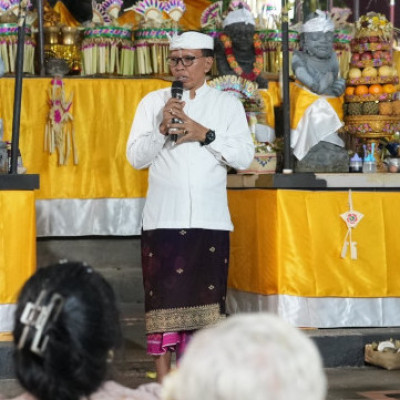
Meanwhile, Director of Hindu Religious Affairs Ida Bagus Kt Drana Arimbawa, who attended on behalf of the Director General of Hindu Community Guidance, explained that Deepavali celebrates the victory of light over darkness, knowledge over ignorance, and Dharma over Adharma.
He noted that Deepavali shares common spiritual values with Galungan, a major Hindu festival celebrated in Indonesia. Both observances convey the triumph of Dharma, although they are expressed through different traditions and ceremonial symbols.
“The forms may be different, but the spirit is one,” he said, highlighting the bonds of brotherhood between Hindu communities in India and Indonesia, both of which are rooted in the teachings of the Vedas.
He also reminded the community that the struggle to uphold Dharma begins with mastering the six inner enemies, known as Sad Ripu: kama, lobha, krodha, mada, moha, and matsarya. These represent uncontrolled desire, greed, anger, arrogance or intoxication, delusion, and jealousy.
“The light we light in our homes only has meaning when the lamp within our hearts is also burning,” the Director of Hindu Religious Affairs emphasized.
Furthermore, he reaffirmed the Directorate General of Hindu Community Guidance's commitment to serving all Hindus across Indonesia, regardless of their ethnic backgrounds, traditions, or sampradaya (religious traditions or lineages). Strengthening religious services, Hindu religious education and pasraman, religious counseling, and religious moderation remain central to its efforts to foster a harmonious Hindu community.
He also encouraged the community to kindle three lights in their lives: jnana, the light of knowledge and wisdom; bhakti, devotion to God; and seva, selfless service to others regardless of their religion or ethnicity. Together, these values embody the Hindu teaching of Tat Tvam Asi, which emphasizes the recognition of the self in others and the importance of compassion in social life.
The Deepavali celebration served as a reminder that the triumph of Dharma must be reflected in concrete actions, including mutual respect, compassion for others, and a shared commitment to preserving harmony amid diversity. These values are expected to continue serving as a foundation for strengthening brotherhood and nurturing harmony in Indonesia's national life.
Editor : I Made Juni Saputra
Photographer : I Gusti Ngurah Sathya Dharma