
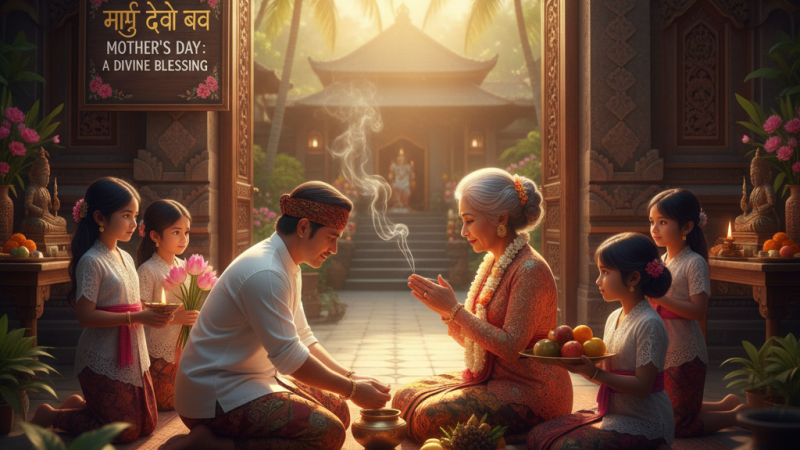
Every 22 December, Indonesian commemorates Mother’s Day—a special occasion marked by ceremonies and expressions of gratitude for Mother’s love. Beyond the celebratory atmosphere, Hindu teachings place the role of a mother in a profoundly transcendent position. In the Vedic tradition, honoring mother is not merely a social obligation, but a form of Yadnya (sacred sacrifice) and a spiritual path leading toward liberation.
Viewed from Hindu philosophy, a mother is revered as Pratama Guru—the First Teacher. Long before a child learns letters or profound philosophical teachings from an Acharya (spiritual teacher), there is mother who imparts the earliest lessons of love, language, and morality. During pregnancy, she instills the seeds of Dharma (righteousness) into the child’s soul. Without this foundational guidance, an individual’s spiritual development becomes fragile, regardless of the level of formal education attained.
The Taittiriya Upanishad (I.11.2) gives a clear and powerful instruction:
“Matru Devo Bhava”
“Revere your mother as God.”
This profound statement does not suggest the literal worship of a human being, but rather acknowledges the divine radiance of God (Devi) manifested through a mother’s selfless love and devotion.
Hinduism places such high reverence on mothers because their service is considered immeasurable and beyond material recompense, as affirmed in numerous sacred texts. The Manawa Dharmasastra (II.145) establishes an extraordinary hierarchy of respect: if a father deserves one hundred times more reverence than a teacher, then a mother deserves one hundred thousand times more reverence than a father. This symbolic expression emphasizes that a mother’s sacrifices transcend material value and human logic.
Similarly, in the epic Mahabharata (Adi Parva), during the dialogue between Yudhishthira and the Yaksha, Yudhishthira states that “a mother is heavier (more noble) than the earth.” This metaphor reflects the boundless patience, endurance, and capacity of a mother’s love, surpassing even the vastness of the land itself.
Viewed from a theological perspective, honoring mothers in human life mirrors reverence for the Universal Mother (Matrika). Within the concept of Shakti, God is worshipped as the Divine Mother—Durga, Lakshmi, and Saraswati. When we honor our mother, we are actually practicing devotion to the creative aspect of the universe. Without this maternal energy—love, care, and protection—the cosmic order (Dharma) would inevitably collapse.
Based on Hindu perspective, celebrating Mother’s Day does not require extravagance. Instead, it is best expressed through sincere daily practices, such as:
Matru Sewanam: Serving mother with sincerity and devotion. In the Ramayana, Sri Rama exemplifies that a child’s highest duty is to uphold the happiness and well-being of their parents.
Aradhana (Prayer): Praying for a mother’s health, safety, and well-being in daily worship.
Emulating the Earthly Nature: Learning patience, compassion, and selfless sacrifice from a mother, practiced through Niskama Karma—action without expectation of reward.
For Hindus, Mother’s Day serves as a moment of spiritual reflection—a reminder to assess how faithfully sacred teachings on honoring mothers have been practiced. A mother is the first bridge connecting a human being to God. Causing emotional pain to one’s mother is regarded as a grave moral transgression that may obstruct spiritual growth. As expressed in the Rig Veda:
“A mother protects her child, just as the earth protects all living beings.”
May this Mother’s Day serve as a gentle reminder that divine blessings and grace flow through a mother’s prayers and loving smile. Last question to be remembered: have we sought her forgiveness and offered her our warmest embrace today?