

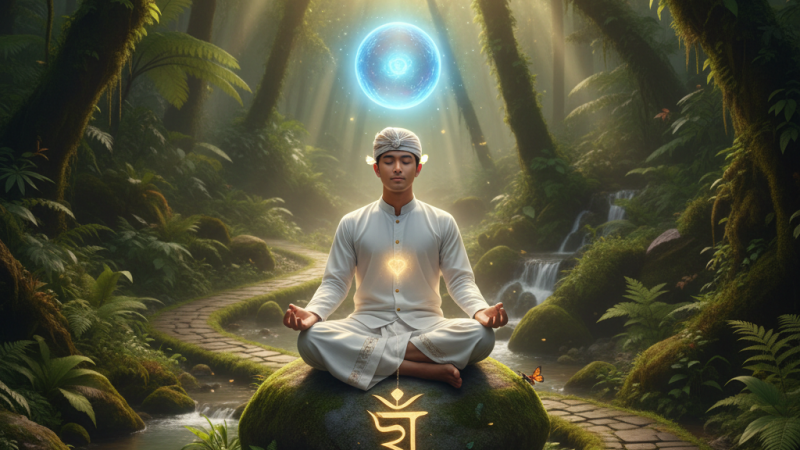
Living in the face-paced world of modern life, we often find ourselves trapped in routines that demand non-stop productivity. Our body is pushed beyond its limits, while the soul is frequently neglected. This condition gives rise to inner imbalance, resulting in anxiety, exhaustion, and a diminishing sense of life’s meaning. In this context, Hindu teachings remain profoundly relevant, as they have long emphasized the balance between body and soul as the essential foundation of a complete and dignified human life.
Hinduism views human beings as an inseparable unity of physical, mental, and spiritual dimensions. The body is not merely a biological entity, but a sacred instrument through which dharma is fulfilled. The soul, as the center of consciousness, provides direction and meaning to every human action. When physical well-being is pursued without regard for inner tranquility, individuals are prone to greed and spiritual fatigue. Conversely, when spiritual pursuits neglect physical responsibility, life becomes unbalanced and disconnected from social realities. Therefore, maintaining harmony between body and soul is not a matter of personal preference, but a moral and spiritual imperative.
The principle of Tri Hita Karana serves as a vital foundation in cultivating this balance. Harmony between human beings and God, among fellow humans, and between humanity and nature guides individuals to live in alignment both outwardly and inwardly. Balance between body and soul cannot be achieved through individual effort alone, but requires collective awareness that human life is intrinsically connected to social and natural environments. When these relationships are nurtured with mindfulness and responsibility, inner peace and physical well-being emerge naturally.
In addition, the doctrine of Catur Marga affirms that the path toward balance is not singular. Bhakti Marga nurtures spiritual refinement through sincere devotion; Karma Marga builds discipline of body and mind through selfless action; Jnana Marga deepens awareness through knowledge and wisdom; and Raja Marga cultivates self-control and inner serenity through meditative practice. Together, these four paths complement one another, allowing each individual to find the most appropriate way to care for body and soul according to personal capacity and social responsibility.
The balance between body and soul is further reflected in a simple, disciplined, and mindful way of life. Hindu teachings emphasize the regulation of daily habits, the control of desire, and the alignment between material needs and spiritual awareness. A body maintained through discipline, wise dietary practices, and behavior grounded in dharma supports inner calm. At the same time, a tranquil and conscious soul guides physical actions to remain ethical, responsible, and beneficial.
Within social life, this balance encourages Hindus to become compassionate, tolerant, and constructive members of society. Physical health enables individuals to work, serve, and contribute, while inner clarity ensures that actions are guided by empathy and do not harm others. Thus, balance between body and soul does not remain confined to the personal realm, but extends outward as positive energy that strengthens social harmony.
Ultimately, the pursuit of balance between body and soul in Hinduism is a continuous process of awareness and self-alignment. Balance is not a static condition, but an ongoing effort to harmonize thoughts, actions, and life goals with the values of dharma. Amid the challenges of the modern era, Hindu teachings remind us that true happiness is found when the body is cared for wisely and the soul is nurtured with spiritual consciousness. From this balance emerges a life that is peaceful, meaningful, and in harmony with the universe.