
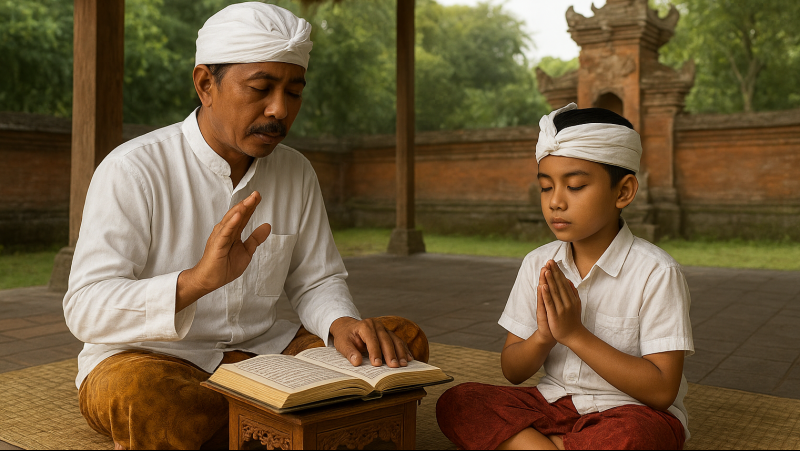
Jakarta (BIMAS HINDU) – Viewed from Hindu philosophy, a teacher holds an exceptionally revered position. A Teacher is not merely an educator in a classroom, he has wider roles in spiritual, moral, and intellectual. He guides and leads humanity toward ultimate truth. Hindu scriptures illuminate teacher as a light that guides people from the darkness of ignorance (avidya) into the radiance of knowledge (vidya). For this reason, Hindu honor teacher as a manifestation of the divine in human form.
The concept of teacher is rooted in the belief of true knowledge is not obtained solely from literatures, but through a profound spiritual relationship between the teacher (the provider of knowledge) and the sisya (the student). A teacher is someone who understands universal truth and bears the moral responsibility to guide students toward moksha—the liberation of the soul from materialistic things.
The Sarasamuscaya, one of Hinduism’s keys ethical text, states:
“A Teacher deserves reverence because he is the source of sacred knowledge, the guide toward virtue, and the illuminator of inner darkness. A Teacher is like a deity who leads people from avidya to true wisdom.”
This value illustrates the essential role of the teacher on balancing between knowledge, morality, and spirituality. In the context of modern education, this philosophy forms the foundation for building a system that not only develops intellectual abilities but also cultivates character and virtue.
Based on Hinduism, education is inseparable from dharma—the moral and spiritual principles that guide human life. A teacher is responsible for implementing values of dharma such as honesty, discipline, responsibility, and compassion for all beings (ahimsa).
Through the role-modelling as a teacher, students learn that knowledge without morality becomes mere intellectual arrogance. A true teacher not only teaches what is right but also demonstrates how to live righteously.
Today’s rapidly globalized and high technologically advanced world, these values are often overshadowed. Therefore, Hindu teachers play an essential role as moral guardians, ensuring that younger generations remain grounded while navigating modern life. They help students stay rooted in dharma, even as they adapt to a fast-paced and competitive environment.
One unique aspect of Hindu tradition is the parampara system—a lineage of knowledge passed down from teacher to student across generations. This system preserves the purity and relevance of sacred teachings throughout time. Teachers not only teaching the essence of the Vedas, Upanishads, or Itihasa but also embodying and transmitting the spirit of wisdom, purity, and compassion contained within these books.
Through Parampara system, teachers become guardians of tradition while also serving as reformers of civilization. They interpret ancient teachings so they remain meaningful in the modern era. Today’s, Hindu teachers face the challenge of conveying timeless values in ways that resonate with the digital generation—without diminishing their philosophical depth.
While modern education often focuses on intellectual and technological skills, Hinduism emphasizes that true education unites mind, heart, and soul. Here, role of the teacher is central: only through wise and compassionate guidance can students discover the deeper meaning of life.
Hindu teachers are expected to be sources of inspiration in an increasingly materialistic world, teaching balance between scientific advancement and noble character. Therefore, they are not merely educators but cultivators of humanity and carriers of dharma’s wisdom.
Honoring one’s spiritual teacher is regarded in Hindu tradition as one of the highest forms of bhakti (devotion). Students are taught to be respectful, obedient, and humble. This respect is not limited to ceremonial; it is expressed through living the teacher’s advice, upholding their dignity, and continuing their teachings in everyday life. This makes the teacher–student relationship not just a formal educational bond but a sacred connection that shapes a dharma-based civilization.
Despite changing era, the role of teacher in Hindu teachings remains timeless and irreplaceable. A teacher is a guiding light on the path of wisdom, helping people become not only intellectually capable but also spiritually mature and morally grounded.
As written in the Mundaka Upanishad:
“Approach a teacher who has realized the truth; with sincerity and devotion, listen to their teachings, and you shall find enlightenment.”
Teachers guide the soul and build the character of a nation. Through their guidance, young Hindus can grow into knowledgeable individuals of noble character, rooted in dharma. For this reason, spiritual teachers deserve deep respect—not only for their knowledge but for their role in sustaining the light of wisdom within humanity.
Kontributor: Muhammad Mahmud Alhushori
Editor: Jaya Perdhana
Ilustrator: I Gusti Ngurah Sathya Dharma