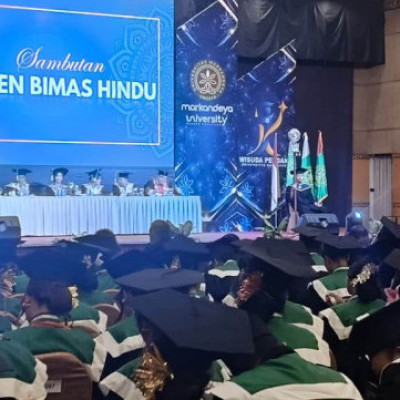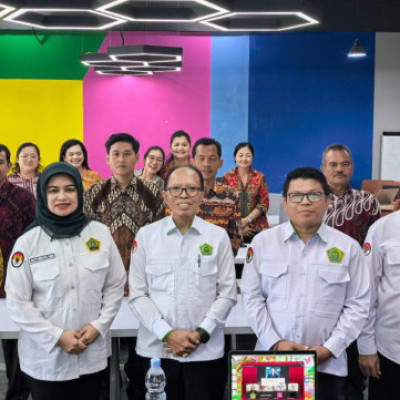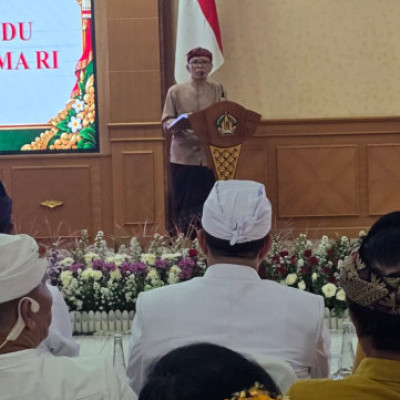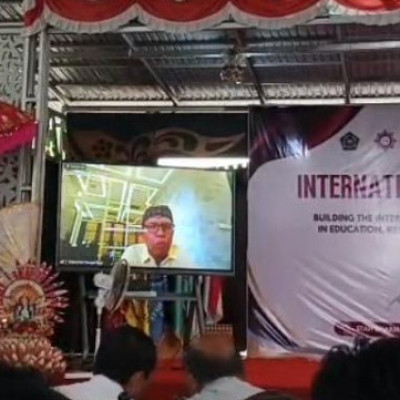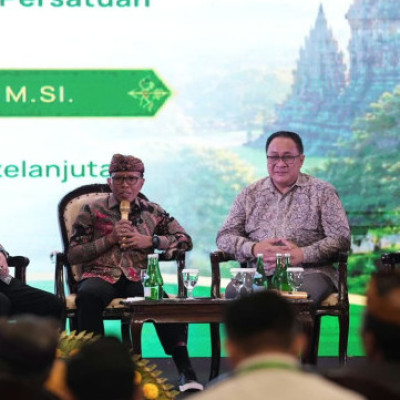

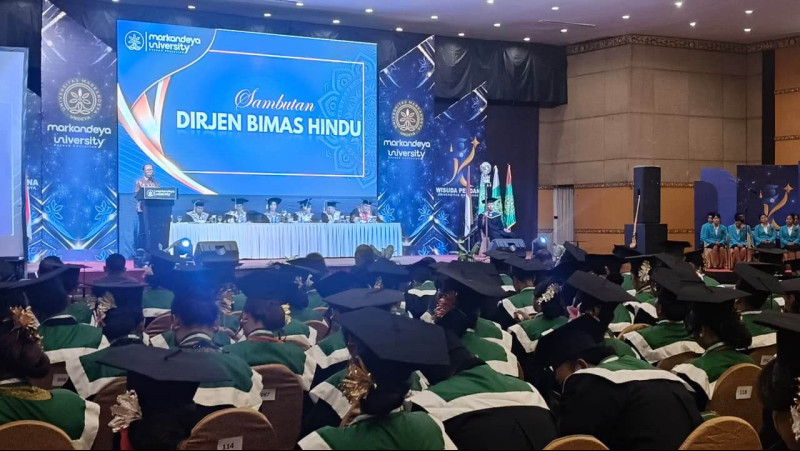
Director General of Hindu Community Guidance at the Ministry of Religious Affairs, Prof. I Nengah Duija, attended the inaugural graduation ceremony of Markandeya University’s Class of 2026 at the Aston Denpasar Hotel on Tuesday (October 27, 2026). On the occasion, he emphasized that university graduates must balance technological proficiency with integrity and strong character to navigate changing times and make meaningful contributions to society.
Prof. Duija noted that the rapid development of digitalization and artificial intelligence (AI) presents both opportunities and challenges for younger generations. These developments require graduates to continually enhance their competencies, think critically, and adapt to advances in science and knowledge without compromising their moral responsibilities.
“Technology can expand human capabilities, however Dharma guides people in using those capabilities wisely. Intelligence can lead a person toward progress, but character determines the direction that progress takes,” Duija said in his remark.
He stated that higher education must do more than award academic degrees. Universities also have a responsibility to develop human resources who are professional, possess integrity, and can apply their knowledge to address the needs of society.
He highlighted the Hindu teaching of Tri Kaya Parisudha, which emphasizes purity of thought, speech, and action. These values, he said, provide a relevant foundation for graduates to build professionalism, uphold honesty, and take responsibility for their decisions and work.
“The employment sector and society need competent and trustworthy human resources. Therefore, honesty must go hand in hand with expertise, professionalism should be supported by responsibility, and success must be balanced with concern for others,” he said.
Prof. Duija also reminded graduates that technological proficiency noted that the ability to assess the accuracy of information and make responsible decisions. While technology can accelerate work processes and facilitate the generation of information, he stressed that people remain accountable for the soundness of their decisions and the consequences of how technology is used.
In this regard, the values of Dharma should be practiced not only in religious life but also in academic activities, the advancement of knowledge, and professional conduct. With these values as their foundation, graduates are expected to keep pace with changing times while maintaining their integrity in both their personal and professional lives.
Beyond emphasizing character and technological skills, Duija encouraged the graduates to turn their knowledge into meaningful contributions. He emphasized that educational success should not end with graduation but should be demonstrated through innovation, problem-solving, and service that delivers tangible benefits to society.
“Knowledge should not stop at theoretical understanding or serve merely as an academic degree. It must be implemented into competence, innovation, problem-solving, and service that brings tangible benefits to society,” he emphasized.
This message reflects the Hindu teaching of Karma Yoga, the path of selfless service through responsible and sincere action. Duija encouraged graduates to make the best possible contributions in their respective fields, whether through professional work, innovation, or active involvement in addressing challenges within their communities.
Addressing the university’s boards and academic community, he also urged them to use this inaugural graduation ceremony as an opportunity to improve educational quality, advance research, and strengthen innovation that responds to society’s needs. The quality of graduates and their achievements, he noted, would help shape the university’s reputation and public trust.
As members of the university’s first graduating class, the graduates bear a responsibility to uphold their alma mater’s reputation through their competence, conduct, and tangible achievements. Graduation, Duija said, is not the end of the learning process but the beginning of a greater responsibility to apply knowledge and benefit others.
Markandeya University’s inaugural graduation marks the beginning of a new chapter for its graduates as they put their knowledge into practice. With their professional competence, integrity, and the values of Dharma, they are expected to meet the challenges of the workplace, adapt to technological developments, and produce work that benefits society.
Contributor : I Made Juni Saputra
Photographer : I Gede Dipayana