
HINDU OPINION ARTICLE
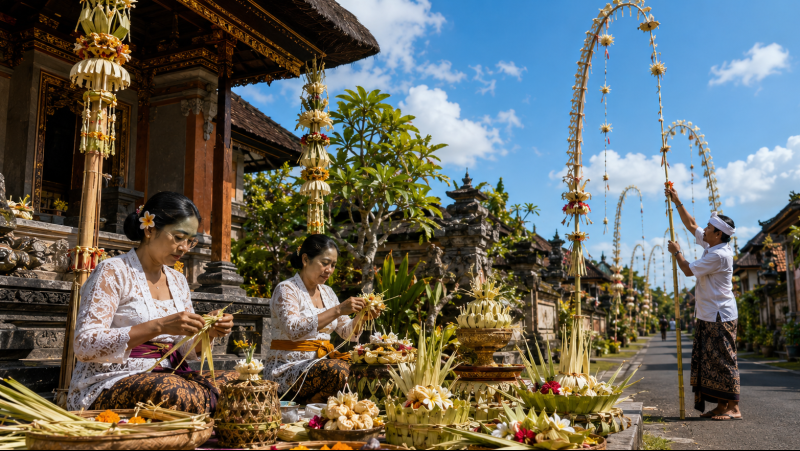
As Galungan approaches, a distinct atmosphere begins to emerge within Hindu communities. Preparations are carried out with great enthusiasm. Courtyards are cleaned, ceremonial offerings are prepared, and penjor begin to decorate the surrounding environment. These activities have become an inseparable part of the Galungan celebration, passed down from generation to generation.
Amid these preparations, however, one important aspect is often overlooked—the deeper meaning of reflection contained in Penampahan Galungan.
Viewed from a broader perspective, Penampahan Galungan is not merely about preparing for a sacred celebration. More than that, it serves as a reminder that every religious observance should begin with inner readiness. The true value of a celebration is determined not only by the perfection of its external rituals, but also by the quality of awareness that accompanies them.
The reality of modern life shows that people are often more occupied with preparing what is visible than paying attention to what is felt within. Many spend considerable time ensuring that every ceremonial need is fulfilled, yet rarely take time to reflect on their attitudes and behavior over the past year.
In fact, when examined more deeply, Penampahan Galungan can be understood as an opportunity for self-evaluation. This moment invites each individual to ask themselves honestly: have we truly lived according to the values of Dharma in our daily lives?
This question is especially relevant because the challenges of modern life are not limited to economic, educational, or technological issues. The greatest challenges often appear in invisible forms, such as declining social awareness, growing individualism, and the increasing ease with which people become involved in conflict due to differences in opinion.
In this digital era, people can express opinions instantly, but that does not necessarily mean they can communicate ethically. People may access vast amounts of information within seconds, yet still struggle to filter it wisely. It is within this context that the values embedded in Penampahan Galungan become increasingly relevant.
Penampahan reminds us that victory is not always synonymous with surpassing others. True victory is achieved when a person is able to master themselves. The ability to restrain anger, reduce prejudice, respect differences, and strengthen compassion for others represents a form of victory that is often far more difficult to attain than material success.
Penampahan Galungan also conveys an important message about maintaining balance. A harmonious life is built not only through one’s relationship with God, but also through healthy relationships with fellow human beings and the environment. These values are reflected in traditions that emphasize togetherness, mutual cooperation, and gratitude.
Therefore, Penampahan Galungan should not be understood merely as part of an annual routine. It deserves to be seen as an opportunity to improve oneself before entering the celebration of Dharma’s victory. The essence of Galungan is not only about celebrating the triumph of goodness, but also about embodying that goodness in everyday life.
Ultimately, the festivity of Penampahan Galungan will pass, just as it has in previous years. The penjor will eventually be taken down, the ceremonial processions will come to an end, and life will return to its usual rhythm. Yet one question remains: will this sacred moment leave a meaningful transformation within us?
If the answer is yes, then Penampahan Galungan becomes more than a tradition celebrated every six months. It becomes a space for continual learning—one that constantly reminds us to grow into individuals who are wiser, more humble, and more committed to living the values of Dharma amid the changing times.
Authored by I Made Juni Saputra
Translated by Muhammad Mahmud Alhushori