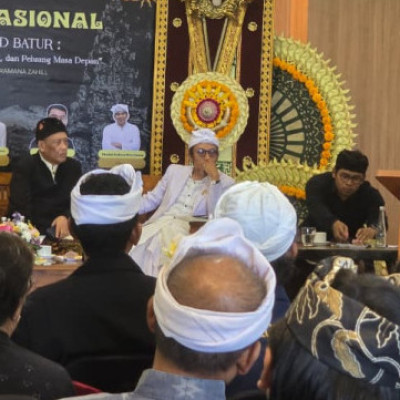


Dharma Wacana
Astungkara, on this blessed occasion, let us all bow our heads for a moment, open our hearts, and realize that the life we live is a truly precious gift. Not everyone is born into the same circumstances; not everyone is given the same path in life; and not everyone faces the same trials. Therefore, today’s Dharma Wacana invites us to reflect on something that is often forgotten: how to be grateful to ourselves, how to avoid easily envying others, and how to cultivate happiness from within. Many people appear to be smiling on the outside, but their hearts are restless on the inside. Many people appear to have enough material, yet their inner selves feel a sense of lack. Thus, true happiness is not determined solely by what we possess, but by how we view life, how we value ourselves, and how we practice dharma every day.
Based on Hindu teachings, human beings are viewed as noble creatures who possess the power to shape their own lives. We are more than just a body, more than just a mind, and more than just emotions. Deep within us lies the atman, a sacred spark of Sang Hyang Widhi Wasa. Therefore, self-respect is not arrogance, but rather the awareness that this life is a sacred trust that must be protected. There is a very beautiful verse from the Bhagavad Gita VI.5 that is often used as a guiding principle: “Uddhared ātmanātmānaṃ nātmānam avasādayet, ātmaiva hy ātmano bandhur ātmaiva ripur ātmanaḥ.” This means that one should uplift oneself through one’s own efforts, not bring oneself down, for the self is both a friend to the self and can also be an enemy to the self. This verse teaches that happiness and misery often originate from within ourselves. When our minds are clear, our hearts are calm, and our actions are in harmony with dharma, then the mind becomes the best companion that guides us toward peace.
Unfortunately, in reality, many people are not kind to themselves. Some constantly blame themselves, feel they aren’t good enough, compare their lives to those of others, and eventually lose their sense of gratitude. In today’s era, this issue is becoming more serious because social media constantly highlights others’ successes, luxuries, and achievements. What we see on the screen is the end result, not the entire process behind it. As a result, someone might feel like their life is falling behind simply because they’re seeing curated snippets of others’ lives. That’s where envy takes root. Envy not only stirs up anger but also erodes joy. People who are envious often cannot enjoy the blessings they already have, because their minds are preoccupied with what others possess. In reality, envy never moves us forward. Envy only narrows the heart, darkens the mind, and strains social relationships.
The root of envy often lies in a lack of gratitude and a lack of self-awareness. Someone who is unaware of their own strengths and life’s journey easily feels small in the presence of others. They forget that every person has their own path of dharma. Some are blessed with intelligence, some with energy, some with patience, some with opportunities, and others are being forged through trials. If we force ourselves to judge life by a single standard, we will continue to feel like losers. Another cause is unhealed emotional wounds. People who have been belittled, have failed often, or were raised in an environment full of comparisons often carry a lack of self-confidence into adulthood. When they see others succeed, what arises is not joy, but a sense of being left behind. This is why we need to heal our perspective on ourselves first.
How do we overcome these matters?
The first step is learning to accept yourself honestly. Accepting yourself does not mean giving up without trying, but rather acknowledging your current situation as a starting point for growth. We need to tell ourselves: I’m still learning, I’m still a work in progress, and that’s okay. The Bhagavad Gita IV.22 teaches, “Yadṛcchā-lābha-santuṣṭo dvandvātīto vimatsaraḥ, samaḥ siddhāv asiddhau ca kṛtvāpi na nibadhyate.” This means that a person who is content with whatever is reasonably obtained, transcends joy and sorrow, is free from envy, and remains the same in both success and failure, will not be bound by their actions. This verse affirms that inner contentment is the foundation of peace. Once the heart has learned to be content, life is no longer filled with the urgency to always be like others.
The second step is cultivating a daily habit of gratitude. Gratitude should not be expressed only when we receive something wonderful, but also when we are still given the gift of breath, good health, the opportunity to work, family, friends, and time to improve ourselves. A grateful person doesn’t turn a blind eye to problems, but chooses to see the blessings that are right in front of them. Waking up in the morning is a blessing. Being able to move your body is a blessing. Having even a simple meal on the table is a blessing. Even when we’re facing challenges, we’re still given the chance to learn and become stronger. With a grateful heart, a person is less prone to envy, because they realize their own life is filled with blessings worthy of appreciation. Gratitude softens the heart, clears the mind, and makes our words more courteous. Grateful people tend to smile more easily, are more willing to help, and face situations with greater peace of mind.
The third step is redefining the standard of success. Based on Dharma, success is not merely a matter of wealth, status, or praise, but rather whether our lives are drawing closer to truth, virtue, and balance. Therefore, stop using other people’s lives as the primary measure of our own. Other people’s lives are their own; our lives are our own paths. Some people may appear to have succeeded sooner, but that doesn’t mean they are happier. Some people live simply, yet their hearts are at peace. Some people are not well-known, yet they show kindness every day. This is where we learn that happiness is not synonymous with luxury. Happiness arises when thoughts, words, and actions align with dharma. The Bhagavad Gita II.47 reminds us, “Karmany evādhikāras te mā phaleṣu kadācana.” We are entitled to our work and efforts, but not to the results, which are entirely in God’s hands. Therefore, what we must focus on is the quality of our efforts, not merely comparing outcomes.
Furthermore, we need to understand that envy often arises when our hearts are too busy looking outward and not looking down enough. Looking outward without restraint makes us easily shaken by the lives of others. However, looking down means recognizing our own thoughts, emotions, and intentions. When we realize that life is a journey to be lived, not a race to be won, our hearts become calmer. Don’t view others’ success as a threat. Others’ success should serve as inspiration, as long as we interpret it with a healthy mindset. We can learn from them, emulate their discipline, and follow their perseverance, but there’s no need to resent them. In fact, when we’re able to say, “They succeeded; I, too, can learn to be more diligent,” that’s when envy turns into motivation. This is the process of inner purification that is so vital to our spiritual life.
The attitude of not being envious is also described in the Bhagavad Gita XII.13, which praises a person who is “adveṣṭā sarva-bhūtānāṃ maitraḥ karuṇa eva ca”—that is, one who harbors no hatred toward any living being, is friendly, and is full of compassion. A person who is free from envy finds it easier to rejoice in others’ successes. They do not feel threatened when a friend succeeds, a sibling advances, or a neighbor prospers. Instead, they are able to say sincerely, “May that goodness bring blessings.” Such an attitude is truly noble, for a generous heart always finds room for love. Within the family, in the banjar, at work, and in the community, an attitude free from envy strengthens brotherhood. Conversely, envy causes relationships to fracture, breeds prejudice, and sparks hurtful words. Therefore, guarding the heart against envy is not only for one’s own peace of mind but also for the sake of collective harmony.
How can we find happiness within ourselves? First, recognize that happiness doesn’t always come from big things. Often, happiness stems from simple things: waking up in the morning with a positive mindset, doing your work diligently, helping others selflessly, or enjoying quiet time with family. Second, don’t be too hard on yourself. It’s okay to reflect on our mistakes, but don’t punish yourself excessively. Mistakes are teachers, not life sentences. Third, take care of your body, mind, and heart in a balanced way. Eating in moderation, getting enough rest, praying, meditating, and reading sacred teachings will help stabilize your inner self. Fourth, train yourself to appreciate the process. Happy people don’t rush to become someone else; instead, they diligently strive to become the best version of themselves. Fifth, make a habit of giving. Giving a smile, giving your time, giving attention, and offering help often brings happiness to your own heart as well.
At this point, it’s also essential for us to learn to speak more gently to ourselves. Many people are kind to their friends but harsh toward themselves. If they fail even a little, they immediately call themselves stupid. If they haven’t succeeded yet, they immediately feel worthless. Yet the words we repeat in our hearts shape our inner state. Therefore, practice healthy inner dialogue:
I am still growing, I am still worthy of love, I can still improve myself, and I still have hope.
This attitude isn’t self-indulgence; rather, it gives the soul space to heal and grow. In spiritual traditions, a gentle mind is far more receptive to the light of wisdom than a mind filled with self-criticism. Thus, being kind to yourself is a tangible part of spiritual practice.
If we look deeper, Hindu teachings always emphasize the balance between outward effort and inner peace. People may work hard, pursue higher education, engage in business, manage their families, and serve the community, but all of this must be accompanied by the awareness that life is not merely a stage for proving oneself. Life is an opportunity to practice yadnya, service, and love. When we work sincerely without obsessing over praise, we become freer. When we help others without expecting anything in return, we feel lighter. When we succeed, we do not become arrogant. When we have not yet succeeded, we do not lose hope. It is this kind of serenity that enables a person to find happiness within themselves. They do not need constant recognition, because they have already found peace within themselves.
In daily life, putting this into practice can start with small things. When you wake up, give thanks for a new day. When you look in the mirror, don’t immediately focus on your flaws, but greet yourself with love and good intentions. When you see others’ successes, train your heart to offer congratulations, not disparaging comments. When you feel left behind, remember that everyone has their own time to reap the rewards of their efforts. During group prayers at home or at the temple, ask not only for success but also for clarity of heart. At home, make it a habit to offer each other appropriate praise, to appreciate family members’ efforts, and to avoid making comparisons a habit. At work, focus on the responsibilities in your hands. On social media, be wise in how you consume information, because not everything that looks beautiful on the screen is actually easy to live out. If your heart begins to feel restless, take a breath, pause for a moment, and then remind yourself that you are precious in God’s presence.
Within the family, especially for parents, it is important to instill the habit of not comparing children. Constant comparisons often hurt feelings and foster jealousy among siblings. Every child has their own strengths and challenges. A parent’s role is to nurture love, not to fuel unhealthy competition. Likewise, teenagers and adults should learn to celebrate small successes. Completing tasks on time, waking up early with discipline, controlling one’s emotions, or being able to forgive others are achievements worthy of appreciation. If we only acknowledge major successes, we will often be disappointed. But if we appreciate the small steps, then life’s journey feels more beautiful and worth being grateful for.
As a more practical lesson, let’s cultivate the habit of living each day with three simple realizations.
First, the realization that I am enough to start this day with gratitude. “Enough” doesn’t mean stopping our growth, but rather stopping the habit of belittling ourselves. Second, the realization that others are not competitors to be defeated, but fellow human beings who are also struggling. When we see a neighbor succeed, we don’t need to feel inferior. When a friend receives a blessing, we shouldn't feel that God is being unfair. Others’ blessings never diminish our own. Third, the awareness that every little action has meaning. A sincere smile, a polite greeting, a heartfelt prayer, work done with care, and words that do no harm are very genuine forms of dharma. If we consistently practice these three forms of awareness, our hearts will become more stable. We won’t be easily swayed by praise, won’t crumble under criticism, and won’t feel envious when we see others’ success. Even in the face of failure, we can remain steadfast because we have trained our minds to breathe in harmony with dharma. This is the kind of spiritual maturity we should cultivate little by little in our daily lives.
Dear Hindus, a peaceful life is not a life without problems, but a life in which one is able to manage problems with wisdom. Gratitude broadens the heart. Being free from envy fosters warm relationships. Being pleased with oneself makes life easier to live. All of this comes together in one teaching: live in harmony with dharma. If we protect our minds from excessive complaining, guard our speech from hurtful comments, and keep our actions free from unhealthy competition, then our inner selves will be more at peace. Do not compare yourself to others. Judge yourself by your own progress, day by day. Today may not be perfect, but as long as we are willing to learn, improve ourselves, and be grateful, we are on the right path. That is the true form of self-love—not indulging the ego, but honoring the atman within.
Let’s remember that God never puts us in the wrong situation. Everyone is given a different path, timing, and lessons, but all of them can lead to a higher level of awareness. If others receive their blessings first, it doesn’t mean we’ve been left behind. If our success hasn’t yet materialized, it doesn’t mean God isn’t watching. Keep doing good, keep praying, keep working sincerely, and keep being grateful for every small step. In this way, we will learn that happiness doesn’t have to be sought far away. Happiness grows when we accept ourselves, appreciate the process, let go of envy, and fill our hearts with gratitude. May this Dharma Wacana bring us benefit, guiding us to live more peacefully, more wholeheartedly, and more happily.
Om Santih, Santih, Santih Om.
Written by Ardika Narasuastika S.Pd
Editor : I Made Juni Saputra
Contributed and translated by Muhammad Mahmud Alhushori