
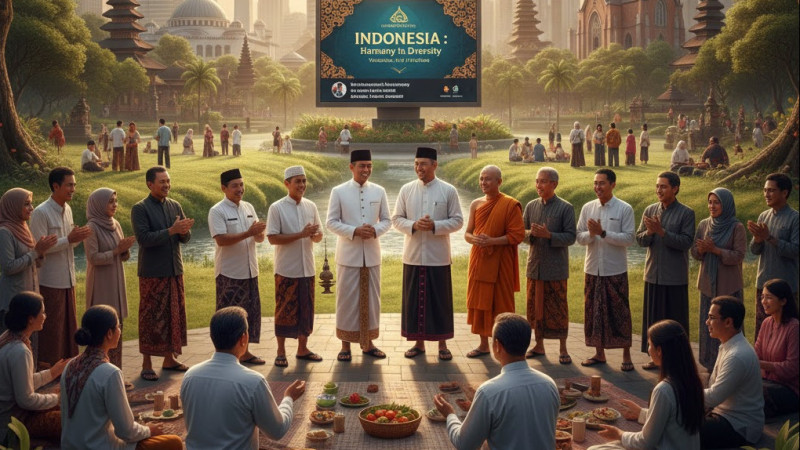
Interfaith harmony is one of the fundamental prerequisites for building a peaceful and harmonious society. Indonesia — a nation rich in diversity — harmony is not merely a social aspiration; it is also a profound spiritual calling for every religious adherent. Throughout history, the Hindu community has been recognized for living peacefully alongside other religious adherents. This attitude is not accidental; it is deeply rooted in Hindu teachings that place the highest value on harmony, balance, and respect for diversity.
Hindu philosophy perceive life as a cosmic system bound by the eternal principle of Dharma. Dharma is far more than ritual duty — it is the fundamental law of truth that regulates relationships between humans and the God, among human beings themselves, and between humanity and the natural world. Within this framework, interfaith harmony is not separate from Dharma; it is an essential expression of it. Therefore, tolerance and open-mindededness have long been integral to the social life of Hindus.
The profound concept of Vasudhaiva Kutumbakam (“the world is one family”) forms the philosophical cornerstone of this worldview. It teaches that differences in religion and belief do not negate the underlying brotherhood of all humanity. In practice, Hindu communities across Indonesia have consistently demonstrated the ability to coexist peacefully with other religious adherent — respecting one another’s places of worship and collaborating in shared social and communal life.
The teaching of Tat Tvam Asi (“Thou Art That”) further strengthens ethical awareness in interfaith relations, guiding Hindus to approach others with empathy and compassion. The enduring harmony that has been maintained reflects a deep understanding that our shared humanity transcends religious identities. Nevertheless, challenges inevitably arise when social changes, competing interests, or external pressures threaten the balance that has been carefully nurtured.
The Balinese Hindu principle of Tri Hita Karana declares that harmony is the very essence of a meaningful life. It calls for equilibrium in three key relationships: with God (parhyangan), with fellow human beings (pawongan), and with the environment (palemahan). Interfaith harmony clearly belongs to the domain of pawongan and has long been a lived practice among Hindus. The recent challenge is to preserve and strengthen this harmony amid rapid social transformation, modernization, and the expansion of digital spaces.
In today’s digital era, Hindus face new challenges in the form of overwhelming flows of information that often lack truthfulness and wisdom. Provocative narratives and hate speech can easily undermine long-established harmony. Here, the teaching of Tri Kaya Parisudha (purity of thought, speech, and action) serves as a crucial ethical guide, encouraging Hindus to think clearly, speak courteously, and act righteously even in the online world. The traditional harmonious character of the Hindu community must be reinforced through greater media literacy and the wise discernment of information.
Beyond external relations, Hindus are also called to deepen their internal understanding of their own faith. Genuine and lasting harmony cannot exist without strong spiritual roots and a thorough grasp of dharma. A solid spiritual foundation enables Hindus to remain open and inclusive while preserving their distinct religious identity.
Ultimately, the challenge facing Hindus in nurturing interfaith harmony is not to invent something entirely new, but rather to protect, strengthen, and creatively adapt an attitude of harmony that has long been an essential part of Hindu identity. By continually bringing the teachings of dharma to life in the modern world, Hindus can continue to serve as an inspiring example of harmonious coexistence and make a meaningful contribution to the realization of a peaceful, united, and dignified Indonesia.