
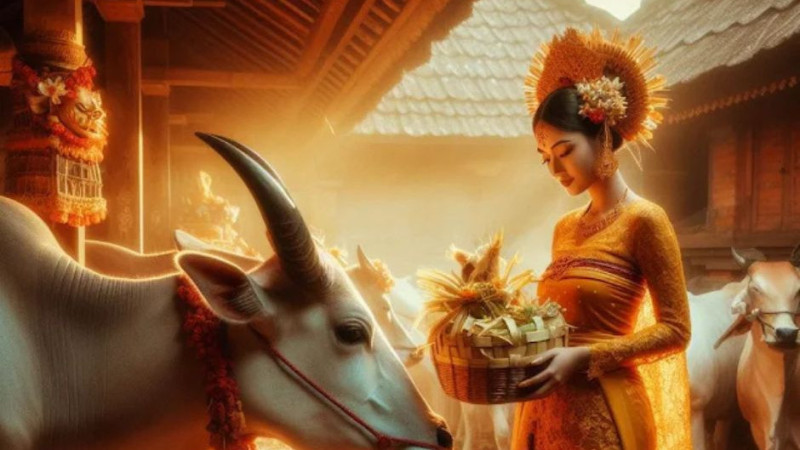
Jakarta (BIMAS HINDU) – In Hindu teachings, especially those who practiced in Bali, human life is inseparable from other living beings, including animals. This philosophy is not merely an abstract philosophy, it can be implemented concretely in the celebration of Holy days, one of them is Tumpek Uye. This holy day serves as a reflection and spirituality moments to show respect, gratitude, and compassion toward animals as part of God’s creation.
Tumpek Uye, which takes place every Saniscara (Saturday) Kliwon Wuku Uye, is a Holy day in the Balinese calendar also known as Tumpek Kandang. The term “kandang” refers to animal shelters or barns, signifying the day is dedicated to honoring and venerating animals, whether kept as livestock or as companions to humans.
In their practice, Hindus will bathe, adorn, offer sesajen (offerings), and pray for animals such as cows, buffaloes, chickens, dogs, cats, birds, and even pet fish. These animals are believed to have significant contributions to human life, therefore they deserve spiritual respect.
According to the teaching of Tat Twam Asi (“I am you, and you are me”), which all living beings are manifestations of the one God, Ida Sang Hyang Widhi Wasa. Therefore, animals are not merely lower creatures to be exploited, but part of the universe that must be respected and treated with compassion.
Tumpek Uye is a real representation of the value of Ahimsa (non-violence), where humans are encouraged to treat animals with kindness, without cruelty, and to establish a harmonious relationship with them. This is in line with teaching of Tri Hita Karana, the Hindu concept of harmonious relationship between human and God (parhyangan), relationship from human another human (pawongan), and relationship of human and nature (palemahan).
Tumpek Uye is not merely ritualistic, but also carries ethical and educational values. Hindus are encouraged to reflect on how they have been treating animals. Are they being fed properly? Are they cared for well? Are humans still exploiting animals purely for individual profit?
Seen from Hindus’ perspective, Tumpek Uye acts as a form of spiritual education that teaches empathy from an early age, especially to children. Children who participate in this religious ceremony learn that animals also have the rights to live decently and be respected.
In today’s environmental crisis, the teachings embodied in Tumpek Uye are highly relevant. Human treatment of animals and nature is often driven by greed, resulting in damaged ecosystems, species extinction, and climate crisis.
Tumpek Uye reminds Hindus that spirituality is not only about one's personal relationship with God, but also about responsibility toward other beings. From a global perspective, these values align with principles of sustainability, animal welfare, and ecological justice.
Times have changed, the deep meaning of Tumpek Uye still be preserved and even further developed. Hindus can use this moment for symbolic rituals also for concrete actions such as:
- Participating in animal conservation movements
- Supporting ethical farming practices
- Avoiding violence toward animals
- Sharing public education on animal protection
Hindu religious and educational institutions can also use Tumpek Uye as a momentum to raise ecological and moral awareness in society.
Tumpek Uye reflects how Hinduism has a holistic and inclusive perspective of life. This Holy day is not just a local tradition, but a reflection of a spiritual civilization that honors all life beings. Tumpek Uye serves as a kindly reminder both of spiritual and environmental are cannot be separated away especially in the world is growing more and more divided.
Celebrating Tumpek Uye, sincerely, Hindus are not only fulfilling a religious duty, but also contributing to the preservation of deep humanitarian and ecological values. This is the true face of Hindu Dharma: a grounded teaching, united with nature, and filled with love for all living beings.
@M.Mahmud_Alhushori (Penerjemah)